Mining and Heavy Industry DC Motor Maintenance: Equipment That Addresses Workforce Challenges
Mining operations confront motor reliability requirements where downtime consequences measure in production losses exceeding tens of thousands of dollars hourly. When a haul truck traction motor fails underground or at a remote pit location, the cascading impacts ripple through entire production systems: ore movement stops, processing plants starve for feed, and revenue disappears while maintenance crews scramble to restore service. This operational reality drives mining companies toward aggressive motor maintenance programs and close relationships with repair facilities capable of rapid, high-quality turnaround.
The regulatory framework governing electrical equipment in mining environments has evolved significantly. The Mine Safety and Health Administration finalized rules in December 2024 updating testing, evaluation, and approval requirements for electric motor-driven mine equipment and accessories used in gassy mines. The rule incorporates eight voluntary consensus standards approved by the American National Standards Institute, providing manufacturers and repair facilities flexibility while maintaining explosion protection requirements essential for underground operations.
This regulatory evolution reflects broader trends toward technology-enabled safety improvements throughout mining operations. Motor repair facilities serving mining customers must understand both the technical specifications governing equipment in hazardous locations and the operational pressures driving maintenance schedules and quality expectations.
The Demanding Operating Environment
DC motors in mining service face conditions that accelerate deterioration far beyond rates experienced in controlled industrial settings. Underground operations expose motors to coal dust, rock dust, and moisture that infiltrate windings and degrade insulation. Surface mining operations subject motors to temperature extremes, abrasive dust, and shock loading from ore handling that stress mechanical components and electrical connections alike.
Haul truck traction motors experience particularly demanding duty cycles. Fully loaded trucks climbing grade from pit floors impose sustained high-current operation that heats windings toward thermal limits. Descending with loads engages regenerative braking systems that reverse current flow, creating additional electrical and thermal stresses. The cumulative effect of thousands of these load cycles progressively degrades motor condition, requiring systematic monitoring and timely intervention.
Mining companies have learned through experience that motor failures during production hours cost far more than planned maintenance during scheduled downtime. This recognition has driven adoption of predictive maintenance programs that track motor parameters, schedule overhauls before failure occurs, and maintain spare motor pools that enable rapid changeouts when intervention becomes necessary.
Repair Quality Impact on Production Economics
The economic consequences of motor quality in mining applications create demanding expectations for repair facilities. A motor that fails prematurely after overhaul not only requires repeat repair expense but imposes production losses that may exceed the motor’s replacement value. Mining maintenance managers evaluate repair facilities based on demonstrated reliability records, favoring shops that consistently deliver motors performing to specification throughout expected service intervals.
The U.S. Department of Energy’s motor systems resources emphasize that dramatic energy and cost savings can be achieved in motor systems through best practices and energy-efficient equipment. Mining operations consume enormous quantities of electrical energy through motor-driven systems, making efficiency improvements valuable beyond the individual motor level. Repair facilities that restore motors to optimal efficiency contribute directly to mining company profitability through reduced energy consumption over motor service life.
Quality assurance systems become competitive differentiators for facilities serving mining customers. Documentation demonstrating adherence to manufacturer specifications, traceability of materials and processes, and verification of performance parameters builds confidence that justifies premium pricing and preferred supplier relationships.
Understanding the broader context for heavy-duty motor repair equipment investment, as examined in Heavy-Duty DC Motor Repair Equipment: The Technology Reshaping Industrial Maintenance, reveals common challenges and solutions applicable across industrial sectors including mining operations.
Equipment Requirements for Mining Motor Specifications
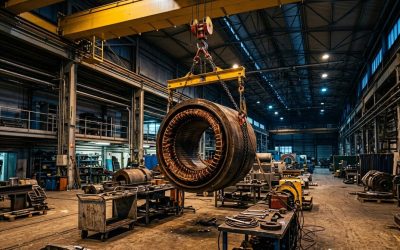
Mining motor applications demand repair equipment capable of handling the weight, dimensions, and precision requirements of heavy-duty apparatus. Armature stands must support loads exceeding those in lighter industrial applications while enabling rotation and positioning for winding, undercutting, and inspection operations. Banding equipment must achieve tension specifications ensuring band integrity under the shock and vibration of mining service.
Automatic mica undercutters prove particularly valuable for mining motor commutators, where consistent slot geometry determines brush performance under the demanding electrical loads characteristic of haul truck propulsion. Manual undercutting introduces variations that may cause uneven brush wear, sparking, and accelerated commutator deterioration. Automated systems eliminate these variations, extending intervals between motor overhauls and reducing total cost of ownership for mining customers.
Armature seasoning equipment enables verification that repaired motors will perform reliably under operating conditions, catching problems before motors return to service. This quality gate prevents field failures that would impose production losses far exceeding repair facility costs, making seasoning capability a competitive advantage when serving mining customers with zero tolerance for unreliable equipment.
The intersection of railroad and mining applications, explored in Railroad and Transit Traction Motor Repair: Meeting Federal Safety Standards Through Equipment Investment, illuminates how similar equipment requirements serve multiple heavy industrial markets.
Workforce Solutions Through Equipment Investment
Mining motor repair facilities face the same skilled labor constraints affecting manufacturing broadly, compounded by geographic factors that limit available workforce in regions where many mining operations concentrate. Rural locations near major mining districts often struggle to recruit workers with specialized skills, making equipment that multiplies existing workforce productivity essential for facility viability.
Modern automated equipment enables operators with less specialized training to achieve quality levels that previously required years of apprenticeship to develop. The equipment incorporates the decision-making and technique that historically resided in skilled workers’ hands and judgment, preserving this capability in programmable form that survives individual workforce transitions.
Training programs for automated equipment typically require weeks rather than years, enabling facilities to bring new operators to productive capability rapidly. This compressed training timeline proves especially valuable when experienced workers retire, allowing facilities to maintain capacity through workforce transitions that would otherwise create capability gaps.
CAM Innovation: Your Partner in Motor Repair Equipment
At CAM Innovation, we specialize in precision equipment solutions for motor repair facilities serving mining and heavy industrial markets. Our team understands the demanding requirements, quality expectations, and production pressures characterizing this sector.
Our Services Include:
- DC Motor Equipment – Automatic mica undercutters, banding machines, armature stands, and processing equipment engineered for mining motor specifications
- Contact CAM Innovation – Discuss equipment solutions for your motor repair facility
Works Cited
“Motor Systems.” U.S. Department of Energy, Office of Energy Efficiency and Renewable Energy, www.energy.gov/eere/iedo/motor-systems. Accessed 25 Nov. 2025.
“Testing, Evaluation, and Approval of Electric Motor-Driven Mine Equipment and Accessories.” Federal Register, 10 Dec. 2024, www.federalregister.gov/documents/2024/12/10/2024-28315/testing-evaluation-and-approval-of-electric-motor-driven-mine-equipment-and-accessories. Accessed 25 Nov. 2025.
Related Articles
- Heavy-Duty DC Motor Repair Equipment: The Technology Reshaping Industrial Maintenance
- Railroad and Transit Traction Motor Repair: Meeting Federal Safety Standards Through Equipment Investment