How AC Motor Winding Equipment Innovations Boost Production Quality

CAM Innovation: Engineering Excellence in Motor Production Technology
The winding process sits at the heart of AC motor manufacturing, directly determining motor efficiency, reliability, and operational lifespan. As global demand for high-efficiency motors intensifies—driven by electric vehicle expansion, industrial automation growth, and increasingly stringent energy efficiency regulations—winding equipment innovations have become critical differentiators separating market leaders from laggards.
Recent advancements in winding technology address fundamental challenges that have constrained motor quality for decades. Electronic tension control systems maintain consistent wire tension regardless of spool diameter or winding speed. Servo-driven positioning delivers wire placement accuracy measured in microns rather than millimeters. Real-time monitoring systems detect and flag quality deviations before they propagate through production runs. These capabilities collectively enable manufacturers to produce windings achieving fill factors and consistency levels that were technically impossible just a generation ago.
The timing of these innovations proves particularly consequential as energy efficiency standards tighten globally. Motors meeting premium efficiency specifications require optimized winding geometries executed with precision that manual processes struggle to achieve consistently. Equipment that can deliver this precision at commercial production volumes represents an essential competitive capability for motor manufacturers serving markets where efficiency regulations continue evolving.
The Technical Foundation of Winding Quality
Wire tension during winding directly impacts both electrical performance and mechanical durability of finished motors. Insufficient tension produces loose windings with inconsistent turn spacing that compromise magnetic circuit efficiency. Excessive tension risks wire damage, insulation breakdown, and copper stretching that alters resistance characteristics. The optimal tension window varies with wire gauge, winding speed, and application requirements, demanding equipment capable of maintaining precise control across diverse production scenarios.
Modern winding equipment employs closed-loop feedback systems that continuously monitor and adjust tension in real time. Load cells or strain gauges measure actual wire tension at multiple points along the wire path. Control algorithms compare measured tension against target values and modulate braking force or feed rate to maintain specified conditions. This active control compensates for variables including spool diameter reduction, wire property variations, and speed changes during acceleration and deceleration cycles.
MIT Professional Education programs emphasize that the melding of advanced embedded control, power electronics, and electric machines has created new capabilities for industrial and consumer electromechanical energy conversion systems, with modern product design demanding understanding of electric machine characteristics and associated interactions with electronic drives. This integration of sophisticated controls into production equipment enables precision that pure mechanical systems cannot achieve.
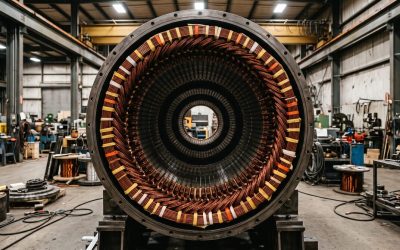
Wire placement accuracy determines how effectively copper fills available stator slots, directly impacting motor power density and efficiency. Orthocyclic winding patterns—where each wire layer nests precisely in grooves formed by the layer below—achieve fill factors exceeding 90 percent when executed properly. Achieving consistent orthocyclic results requires positioning accuracy that only servo-driven systems with precision encoders can deliver reliably.
Understanding how these precision capabilities integrate with broader manufacturing strategies, as explored in Industry 4.0 Reshapes AC Motor Manufacturing Equipment Landscape, provides important context for winding equipment selection decisions.
Automation Impact on Winding Consistency
Statistical analysis of motor production data consistently demonstrates that automated winding equipment produces tighter quality distributions than manual processes. Human operators, regardless of skill and training, introduce variability through factors including fatigue, attention fluctuations, and natural physical limitations. Automated systems maintain identical performance characteristics hour after hour without the drift that characterizes manual operations.
This consistency advantage compounds across production volumes. A manual process with acceptable quality variation at low volumes may produce unacceptable reject rates when scaled to high-volume production. Automated equipment maintains consistent quality regardless of production volume, making it essential for manufacturers serving markets requiring large motor quantities with tight specification compliance.
Quality consistency also simplifies downstream manufacturing operations. When incoming windings exhibit predictable characteristics, subsequent assembly steps can be optimized for specific parameter ranges rather than accommodating wide variation. This optimization cascades through production lines, improving efficiency and quality at each stage.
The National Institute of Standards and Technology’s Manufacturing Extension Partnership works with manufacturers nationwide to implement process improvements that enhance quality and efficiency. According to MEP National Network data, the program helped manufacturers achieve over 15 billion dollars in new and retained sales in fiscal year 2024, with quality improvement initiatives representing a significant portion of that impact.
Documentation and traceability capabilities built into modern winding equipment enable continuous improvement initiatives and customer quality assurance programs. Production data captured during winding operations can be linked to individual motors through serial number tracking, providing complete manufacturing history available for warranty analysis or quality investigations.
Speed and Throughput Advantages
Production speed improvements represent compelling economic drivers for winding equipment investment. Manual winding operations typically achieve production rates measured in units per hour. Automated equipment routinely produces multiple units per minute for small motors, with larger motor winding operations achieving throughput improvements of three to five times over manual alternatives.
These speed advantages translate directly to manufacturing capacity increases without proportional facility expansion. A single automated winding cell may replace multiple manual workstations while requiring less floor space. This footprint efficiency proves especially valuable in facilities with constrained expansion options or high real estate costs.
Changeover time between different motor specifications impacts effective throughput for facilities producing diverse product mixes. Modern winding equipment stores complete recipe libraries enabling rapid changeover through software selection rather than mechanical reconfiguration. This flexibility supports efficient production of smaller batch sizes, enabling manufacturers to serve fragmented markets without sacrificing operational efficiency.
Speed advantages must be balanced against quality requirements for specific applications. Some high-reliability motor applications prioritize quality assurance over throughput optimization, accepting slower production rates in exchange for additional verification steps. Equipment designed for these applications incorporates enhanced inspection capabilities that validate winding quality without sacrificing the consistency benefits of automated production.
Material Efficiency and Waste Reduction
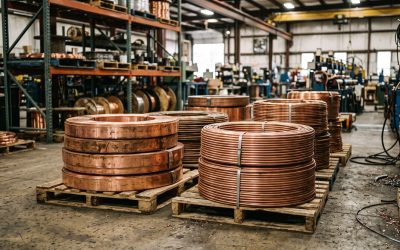
Copper represents a significant cost component in AC motor manufacturing, making wire utilization efficiency economically important. Automated winding equipment optimizes wire usage through precise measurement, controlled cutting, and minimized lead lengths. These small efficiencies compound across high-volume production runs, generating meaningful material cost savings.
Scrap reduction from improved first-pass yield delivers additional material savings. Motors rejected for winding defects represent complete material losses when defects are discovered late in production. Early detection through in-line quality monitoring enables salvage of some materials while preventing additional value-add processing of defective units.
Wire breakage during winding wastes both material and production time. Proper tension control and wire handling minimize breakage incidents, with advanced systems achieving thousands of winding cycles between breaks. When breaks do occur, modern equipment can often resume production with minimal operator intervention, reducing the time impact of individual incidents.
Environmental sustainability considerations increasingly influence manufacturing equipment decisions. Efficient wire usage, reduced energy consumption, and minimized waste generation support corporate sustainability objectives while delivering economic benefits. Equipment suppliers offering documented sustainability advantages gain competitive positioning with manufacturers pursuing environmental performance improvement.
Integration with Quality Management Systems
Modern winding equipment generates rich data streams suitable for statistical process control and quality management system integration. Real-time monitoring of tension, position, speed, and electrical characteristics provides immediate feedback on process stability. Statistical analysis of production data reveals trends requiring attention before they impact product quality.
Integration with manufacturing execution systems enables comprehensive production tracking and documentation. Work order information flows automatically to winding equipment, configuring production parameters for specific motor specifications. Production results flow back to central systems for quality analysis, inventory management, and customer documentation requirements.
Customer quality requirements increasingly demand objective evidence of manufacturing process control. Statistical capability indices, measurement uncertainty analyses, and process control charts demonstrate manufacturing capability in quantitative terms that customers can evaluate confidently. Winding equipment generating appropriate documentation supports customer qualification requirements while building competitive differentiation.
Quality system integration also supports continuous improvement initiatives. Long-term trend analysis identifies equipment degradation requiring maintenance attention. Cross-correlation of quality data with production variables reveals optimization opportunities. Systematic analysis of reject reasons guides corrective action priorities. These improvement capabilities depend on data collection and analysis features built into production equipment.
Workforce development initiatives that prepare technicians to leverage these quality capabilities are addressed in Addressing the Skilled Labor Gap in AC Motor Production Equipment Operations, examining training strategies that maximize return on automation investments.
CAM Innovation: Your Partner in AC Motor Manufacturing Excellence
At CAM Innovation, we specialize in precision winding equipment solutions that enable motor producers to achieve the quality levels their customers demand. Our engineering team combines deep expertise in winding technology with practical manufacturing experience to deliver equipment performing reliably under production conditions.
Our Services Include:
AC Motor Equipment Solutions – Advanced winding systems engineered for precision AC motor production
Custom Engineering – Application-specific solutions addressing unique winding requirements and production challenges
Ready to Enhance Your Winding Operations? Contact CAM Innovation to discuss how advanced winding equipment can improve your production quality and manufacturing efficiency.
Works Cited
“Design of Electric Motors, Generators, and Drive Systems.” MIT Professional Education, Massachusetts Institute of Technology, professional.mit.edu/course-catalog/design-electric-motors-generators-and-drive-systems. Accessed 10 Dec. 2025.
“Manufacturing Extension Partnership (MEP).” National Institute of Standards and Technology, U.S. Department of Commerce, www.nist.gov/mep. Accessed 10 Dec. 2025.
Related Articles