Industry 4.0 Reshapes AC Motor Manufacturing Equipment Landscape

CAM Innovation: Engineering Excellence in Motor Production Technology
The global AC motor manufacturing equipment market is experiencing a fundamental transformation as Industry 4.0 technologies reshape production capabilities across the sector. With AC motors commanding approximately 70 percent of the global electric motor market and the broader electric motor industry projected to reach over 285 billion dollars by 2035, equipment manufacturers are racing to deploy smart automation systems that deliver unprecedented precision, throughput, and quality consistency.
This technological evolution arrives at a critical inflection point for motor producers worldwide. Electric vehicle adoption continues accelerating, HVAC systems demand increasingly efficient motors for commercial and residential buildings, and industrial automation applications require robust AC motors capable of withstanding continuous operation under demanding conditions. Manufacturing equipment that can meet these diverse requirements while maintaining tight tolerances and high production volumes represents the new competitive battleground.
The integration of artificial intelligence, machine learning, and Internet of Things connectivity into AC motor production equipment marks a departure from previous generations of manufacturing technology. Where earlier automation focused primarily on replacing manual labor with mechanical systems, today’s intelligent equipment actively optimizes its own performance, predicts maintenance requirements, and adapts to changing production conditions in real time.
The Scale and Scope of AC Motor Market Demand
The electric motor manufacturing sector accounts for a substantial portion of industrial electricity consumption across developed economies. According to the U.S. Department of Energy’s Advanced Manufacturing Office, electric motors used for machine drives in manufacturing applications account for approximately 54 percent of industrial electricity consumption. This massive energy footprint drives continuous demand for motors achieving ever-higher efficiency ratings, which in turn requires manufacturing equipment capable of producing components with tighter tolerances and more consistent quality.
The U.S. Bureau of Labor Statistics reports that the electrical equipment, appliance, and component manufacturing subsector—which includes electric motors, generators, and transformers—employs over 400,000 workers nationally. This workforce operates increasingly sophisticated production equipment that blends traditional electromechanical expertise with advanced digital capabilities.
Induction AC motors dominate industrial applications, representing roughly 70 percent of total AC motor market share due to their robustness, cost-effectiveness, and low maintenance requirements. These workhorses power everything from HVAC systems and water pumps to conveyor belts and compressors. Manufacturing equipment designed for induction motor production must accommodate diverse specifications while maintaining the efficiency and consistency that end users demand.
Synchronous AC motors, while comprising a smaller market segment, are growing rapidly in applications requiring precise speed control and high power density. Electric vehicle traction motors, wind turbine generators, and precision industrial equipment increasingly rely on synchronous designs that demand sophisticated manufacturing processes and specialized production equipment.
Smart Manufacturing Technologies Driving Transformation
Modern AC motor production equipment increasingly incorporates embedded sensors that monitor every aspect of the manufacturing process. Temperature sensors track thermal conditions affecting material properties and dimensional accuracy. Vibration sensors detect anomalies indicating equipment wear or process deviations. Current and voltage monitors verify that winding operations achieve specified electrical characteristics.
This sensor data feeds into machine learning algorithms that continuously refine production parameters. When the system detects subtle correlations between environmental conditions and output quality, it automatically adjusts settings to maintain optimal results. Over time, these adaptive systems develop deep knowledge of production variables that would take human operators years to accumulate through experience alone.
Predictive maintenance capabilities represent one of the most valuable applications of smart manufacturing technology in motor production. Rather than following fixed maintenance schedules that may service equipment too frequently or too rarely, intelligent systems analyze operational data to predict when specific components will require attention. This approach maximizes equipment uptime while minimizing unnecessary maintenance activities.
The convergence of these technologies enables what manufacturers increasingly describe as “lights-out” production capabilities—the ability to operate production equipment continuously with minimal human intervention. While truly autonomous manufacturing remains aspirational for most facilities, the trajectory toward increasingly automated and self-managing production systems is unmistakable.
As manufacturers evaluate how to capitalize on these technological advances, understanding How AC Motor Winding Equipment Innovations Boost Production Quality provides essential context for equipment selection and implementation strategies.
Precision Requirements in Modern AC Motor Manufacturing
AC motor performance depends critically on manufacturing precision across multiple component systems. Stator windings must achieve consistent wire placement, proper insulation, and uniform magnetic characteristics. Rotor assemblies require tight dimensional tolerances and balanced mass distribution. Air gaps between rotating and stationary components must be maintained within extremely narrow ranges to optimize efficiency and minimize energy losses.
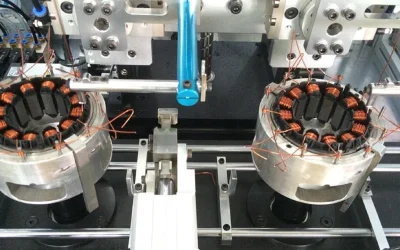
Meeting these precision requirements at commercial production volumes demands manufacturing equipment engineered specifically for tight-tolerance operations. Servo-driven winding systems position wire with micron-level accuracy. Automated assembly stations verify component placement using machine vision systems. In-line testing equipment validates electrical characteristics before motors proceed to subsequent production stages.
The economics of precision manufacturing favor automated equipment over manual processes as tolerance requirements tighten. Human operators, regardless of skill level, introduce variability that accumulates across production steps. Automated systems maintain consistent accuracy hour after hour, shift after shift, producing motors with statistical quality distributions far tighter than manually assembled alternatives.
This precision advantage becomes especially pronounced for high-efficiency motor designs. Premium efficiency motors achieve their performance advantages through optimized electromagnetic designs that require precise execution during manufacturing. Winding patterns, air gap dimensions, and magnetic circuit geometries must match design specifications exactly to realize intended efficiency gains.
Workforce Implications and Skill Requirements
The transformation of AC motor manufacturing equipment creates both challenges and opportunities for the workforce operating these systems. Traditional skills in machine operation, mechanical maintenance, and quality inspection remain valuable, but increasingly must be supplemented with competencies in digital systems, data analysis, and automated equipment programming.
Manufacturers pursuing automation investment must simultaneously address workforce development needs. Equipment that technicians cannot operate, troubleshoot, or maintain effectively delivers diminished value regardless of its theoretical capabilities. Successful automation initiatives pair technology investment with comprehensive training programs that build internal expertise.
The labor market for manufacturing automation skills remains extremely competitive. Companies implementing advanced AC motor production equipment often find that recruiting workers with relevant experience proves difficult, making internal training and development programs essential strategic investments.
This workforce challenge intersects with broader industry trends explored in Addressing the Skilled Labor Gap in AC Motor Production Equipment Operations, which examines strategies manufacturers are deploying to build and retain the technical expertise their automated systems require.
Return on Investment Considerations
Capital investment in advanced AC motor manufacturing equipment requires careful analysis of both costs and benefits across multiple dimensions. Equipment purchase prices represent only one component of total investment; installation, integration, training, and ongoing maintenance costs significantly impact overall economics.
Productivity gains from automated equipment typically exceed those achievable through incremental improvements to manual processes. Production speed increases of three to five times over manual operations are common, with some high-speed automated systems achieving even greater throughput advantages. These gains translate directly to increased manufacturing capacity without proportional increases in facility footprint or workforce requirements.
Quality improvements deliver compounding value over time. Motors manufactured with tighter tolerances and greater consistency exhibit fewer field failures, reducing warranty costs and strengthening customer relationships. The statistical process control data generated by automated systems enables manufacturers to demonstrate quality capabilities objectively when pursuing contracts from demanding customers.
Energy efficiency gains from automated equipment reduce operating costs while supporting sustainability objectives. Modern servo-driven systems consume substantially less power than older pneumatic or hydraulic alternatives while delivering superior performance. LED lighting, regenerative braking, and power factor correction further reduce energy consumption in well-designed automated production systems.
CAM Innovation: Your Partner in AC Motor Manufacturing Excellence
At CAM Innovation, we specialize in precision manufacturing equipment solutions that enable motor producers to meet the demands of rapidly evolving markets. Our team brings deep expertise in AC motor production technology and a commitment to delivering equipment that performs reliably under demanding production conditions.
Our Services Include:
AC Motor Equipment Solutions – Comprehensive production equipment engineered for precision AC motor manufacturing applications
Custom Engineering – Tailored solutions addressing specific production requirements and facility constraints
Ready to Transform Your Production Capabilities? Contact CAM Innovation to discuss how advanced manufacturing equipment can enhance your AC motor production operations and competitive positioning.
Works Cited
“Electrical Equipment, Appliance, and Component Manufacturing: NAICS 335.” U.S. Bureau of Labor Statistics, U.S. Department of Labor, www.bls.gov/iag/tgs/iag335.htm. Accessed 10 Dec. 2025.
“Motors.” Better Buildings Initiative, U.S. Department of Energy, betterbuildingssolutioncenter.energy.gov/better-plants/motors. Accessed 10 Dec. 2025.
Related Articles