Stator Core Loss and Lamination Integrity: The Hidden Efficiency Killer in Motor Rewinds
CAM Innovation: Engineering Custom Solutions for Motor Manufacturers and Repair Shops
Every motor rewind carries an invisible risk that rarely appears on the work order: damage to the stator core. While shops focus on the visible copper, the steel underneath quietly determines whether a rewound motor returns to service efficient or permanently compromised. As federal efficiency standards tighten—the U.S. Department of Energy’s energy conservation rule for electric motors pushed many medium motors to Super Premium/IE4 levels, roughly a 20 percent reduction in losses over the prior Premium tier—the margin for core damage has narrowed dramatically.
Core loss is the energy a motor wastes inside its laminated steel core every second it runs, independent of the load it drives. It comes in two forms: hysteresis loss, from the steel’s resistance to constantly reversing magnetization, and eddy current loss, from circulating currents induced within the core itself. Both turn directly into heat and wasted electricity. A motor with elevated core loss runs hotter, costs more to operate, and ages faster—often without any obvious symptom until an efficiency test or a premature failure reveals it.
Why Laminations Exist in the First Place
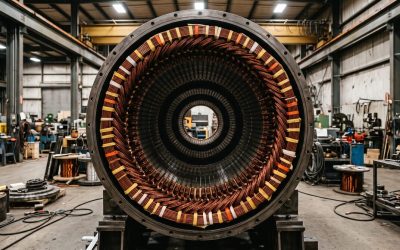
Motor cores are not solid blocks of steel. They are built from hundreds of thin laminations, each coated with insulation and stacked together, precisely to restrain eddy currents. Government-compiled engineering research on electric motors explains that the insulating coating between sheets is what reduces eddy current loss, and that the thinner the laminations and the better the interlaminar insulation, the lower the losses. Damage that bridges those laminations—smearing, burrs, shorted edges, or burned insulation—defeats the entire design and lets eddy currents flow where they should not.
This is the mechanism behind the hidden efficiency killer. When laminations short together, the core behaves more like a solid mass, eddy currents multiply, and losses climb. The damage is often microscopic and entirely invisible to a casual inspection, which is exactly why it slips through so many rewinds undetected.
Where Rewind Damage Comes From
The rewind process itself is the most common source of core degradation. Stripping old windings frequently involves heat, and excessive burnout temperatures can distort laminations, break down interlaminar insulation, and create localized hot spots. Mechanical handling during teardown and rebuild can nick, smear, or compress the core’s tooth edges. Each of these insults raises core loss in the finished motor.
Welding and joining operations add another path to loss. Research on laminated electrical steel has shown that welding can locally degrade the magnetic properties of the steel and measurably increase core losses where the heat is applied. A shop that rebuilds a core without accounting for these effects can return a motor that meets its mechanical specifications yet quietly fails its efficiency ones.
Testing What You Cannot See
Because core damage is invisible, it has to be measured. Core-loss testing energizes the assembled core and measures the losses and heating it produces, exposing distortion, hot spots, and insulation breakdown before new windings are committed. Catching a compromised core at this stage is the difference between a rewind that restores efficiency and one that bakes in a permanent penalty. The same thermal discipline that protects the core also protects the new insulation system—the subject of [PLACEHOLDER: Insulation Thermal-Class Upgrades: How VPI and Resin Extend Motor Life Under Higher Loads].
The Quality Chain Behind Every Rewind
Core integrity does not stand alone. It is one link in a chain that runs from precise coil forming and pressing through controlled curing and careful reassembly. Equipment that forms and presses coils to exact geometry reduces the mechanical stress placed on the core during insertion, and disciplined process control keeps burnout and curing temperatures within safe limits. Even the maintenance of older DC machines, where [PLACEHOLDER: Why Commutator DC Motors Still Dominate Heavy Industry], depends on the same principle: the steel and its insulation must be protected, not just the copper.
For motor manufacturers and repair shops, the lesson is that efficiency is decided long before the final test. A rewind is only as good as the core it is built on, and the core is only as good as the care—and the equipment—used to preserve it.
The Compounding Cost of a Compromised Core
A single point of elevated core loss does not stay contained. The extra heat it generates raises the operating temperature of the entire motor, which accelerates the aging of the very winding insulation a rewind was meant to renew. A motor returned to service with a degraded core therefore pays twice: once in wasted electricity every hour it runs, and again in a shortened second life as the added heat consumes its new insulation faster than expected.
Those costs compound over a motor’s duty cycle. A large industrial motor may run thousands of hours a year, so even a small percentage increase in core loss translates into a meaningful utility bill over time—and, under tightening efficiency standards, potentially into a motor that no longer meets the rating it is sold or specified against. The financial case for protecting the core is not abstract; it shows up on the power bill and on the replacement schedule.
There is a reputational dimension as well. A repair shop that returns motors which run hot and fail early erodes the trust that brings customers back. Core-loss testing and disciplined process control are, in that sense, as much a business safeguard as a technical one. They let a shop stand behind its rewinds with evidence rather than hope.
CAM Innovation: Engineering Custom Solutions for Motor Manufacturers and Repair Shops
CAM Innovation builds the coil forming, pressing, and manufacturing equipment that helps shops protect core integrity through every stage of a rewind. Precise, repeatable coil production reduces the handling stress that drives up core loss and undermines efficiency.
Our Capabilities Include:
- DC Motor Equipment — Commutator repair machines, mica undercutters, TIG welders, and armature handling systems built for heavy-duty service
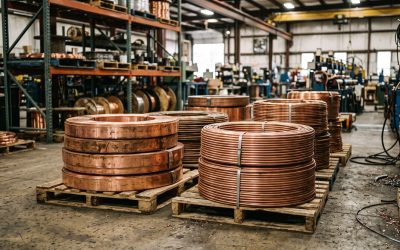
- Coil Manufacturing Equipment — Forming, taping, pressing, and winding systems for precision coil production
Ready to strengthen your operation? Contact CAM Innovation to discuss custom equipment and service solutions for your facility.
Frequently Asked Questions
What is stator core loss?
Core loss is the energy a motor wastes inside its laminated steel core every second it runs, independent of the load. It comes from hysteresis, the steel’s resistance to reversing magnetization, and eddy currents induced within the core itself. Both turn into heat and wasted electricity, so a motor with elevated core loss runs hotter and costs more to operate.
How do rewinds damage the stator core?
The most common culprit is the stripping process. Excessive burnout temperatures can distort laminations and break down the insulation between them, while mechanical handling can nick or smear the core’s tooth edges. Welding and joining operations can also locally degrade the steel’s magnetic properties. Each of these raises core loss in the finished motor.
Why do laminations reduce core loss?
A solid steel core would let large eddy currents circulate freely. Building the core from thin, individually insulated laminations restricts those currents to each thin sheet, sharply reducing loss. When laminations short together through damage, the core behaves more like a solid mass and losses climb.
How can you tell if a core is damaged before rewinding?
Core-loss testing. It energizes the assembled core and measures the losses and heat it produces, exposing distortion, hot spots, and insulation breakdown before new windings are committed. Catching a compromised core at this stage is the difference between restoring efficiency and baking in a permanent penalty.
Works Cited
“Energy Conservation Program: Energy Conservation Standards for Electric Motors.” Federal Register, U.S. Department of Energy, 1 June 2023, www.federalregister.gov/documents/2023/06/01/2023-10019/energy-conservation-program-energy-conservation-standards-for-electric-motors. Accessed 14 June 2026.
“DC Electric Motors: Topics by Science.gov.” Science.gov, U.S. Department of Energy Office of Scientific and Technical Information, www.science.gov/topicpages/d/dc+electric+motors. Accessed 14 June 2026.