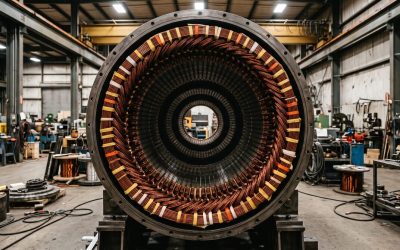
The National Institute for Occupational Safety and Health lists epoxy resins among the industrial compounds that cause allergic contact dermatitis. Its guidance, updated in March 2026, also notes that occupational skin disease is among the most common categories of workplace illness. Anyone who has watched a rotor coil get wound by hand understands why that matters. Epoxy application in rotor coil winding has traditionally meant an open container and a ladle.
That method is disappearing, and skin exposure is only one of the reasons.
What ladling actually costs
Hand application varies. Coverage depends on how much the operator scoops, how fast the coil turns, and how far into the shift the operator is.
Uneven coverage creates two failure modes. Too little resin leaves dry spots between layers. Too much means squeeze-out, mess, and cure time spent on material that does nothing. Neither shows up until later.
An open container introduces a third problem. Epoxy sitting exposed to shop air picks up whatever is in that air.
The closed vessel approach
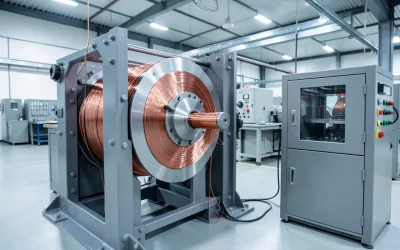
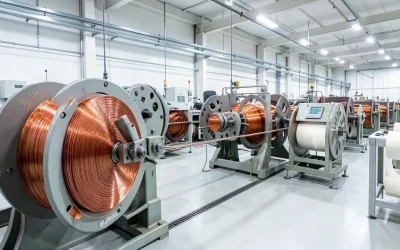
CAM’s Rotor Coil Winding System handles this differently. The epoxy sits in a closed pressure vessel, so it is not exposed to ambient air or airborne contaminants in the container. The system extrudes that epoxy through a small tubular die under pressure at a controlled rate. Winding tension is controlled automatically at the same time.
The operator sequence is short. A 5-gallon epoxy can goes into the pressure tank. A die goes into the applicator. The operator threads the machine, selects a recipe from the touch screen interface, and presses start. The operator does not ladle the epoxy, because it is applied automatically at a controlled rate.
Removing the ladle removes the step where hands and resin meet.
Why the wire has to lie flat for coating to work
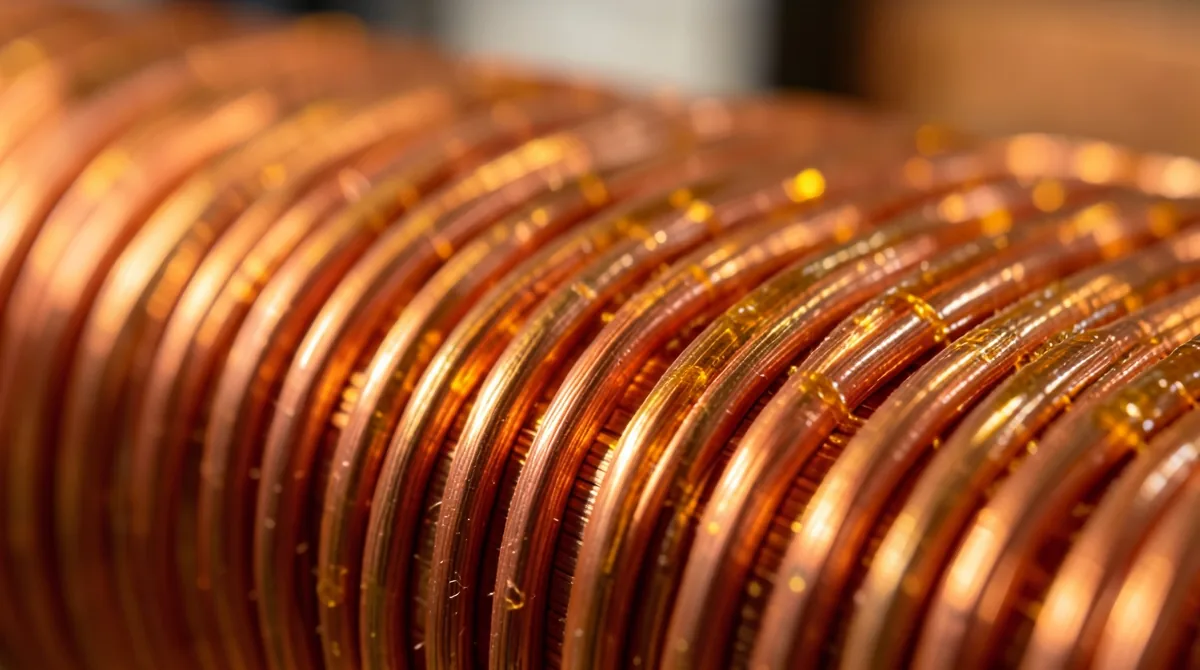
Coating consistency depends on winding consistency. Wire that does not sit flat leaves gaps that resin has to bridge.
The rotor coil system induces a measured back bend in the wire so it lies flat and straight as the traversing mechanism winds it. That back bending is pre-formed as part of the closed loop tension control system rather than handled as a separate operation. Automatic constant tension control holds tension steady as wire velocity changes, with brake torque under PLC control.
The published result is straight, consistent winding layers produced with minimal operator intervention and no hammering. Experienced winders notice the absence of hammering first. Hammering layers flat is exactly the practice that automatic back bending replaces.
Recipes make the process auditable
Automatic tension control is set on a touch screen control console, and recipes for multiple coil types can be run and monitored. A recipe is a record. It says what tension and what sequence produced a given coil type. That beats asking whoever wound it last time.
Material cost has raised the stakes
Copper is no longer a forgiving input. The U.S. Geological Survey reported that the COMEX copper price was projected to average a record $4.80 per pound in 2025, up 14 percent from $4.22 the prior year. Copper joined the U.S. critical minerals list in November 2025.
A rotor coil rejected for dry spots or uneven layers is now an expensive rejection. Process control that felt optional two years ago reads differently at a record price.
What to ask before specifying
Three questions separate shops that get value from automated epoxy application from shops that buy a machine and keep the old habits:
- How many coil types run through the station, and can each one be captured as a recipe
- Who loads the wire spool, and does the loading method suit a crane
- What does the shop currently do about resin on hands, and would removing the ladle change it
On the second question, the dereeler shaft is supported in easy-to-load safety chucks that open only in the home position, with the top half sliding back so the shaft and spool drop in. That restriction is what makes crane loading practical.
Epoxy application in rotor coil winding is one of the last coil shop processes still riding almost entirely on operator judgment. The equipment to change that exists, and the safety case for changing it is documented.
Frequently Asked Questions About Epoxy Application in Rotor Coil Winding
01What is wet winding in rotor coil manufacturing?
Wet winding applies resin to the wire while the coil is being wound rather than afterward. CAM Innovation’s Rotor Coil Winding System controls winding tension automatically while applying epoxy at a controlled rate, so coating and winding happen together in a single pass through the machine.
02Why is epoxy kept in a closed pressure vessel?
An open container leaves epoxy exposed to shop air. On CAM Innovation’s Rotor Coil Winding System the epoxy sits in a closed pressure vessel, so it is not exposed to ambient air or airborne contaminants in the container. The system extrudes it through a small tubular die.
03Does the operator still have to ladle epoxy by hand?
No. The operator places a 5-gallon epoxy can in the pressure tank, inserts a die in the applicator, threads the machine, selects a recipe from the touch screen, and presses start. Epoxy is applied automatically at a controlled rate, so ladling drops out of the job.
04What is back bending and why does it matter in coil winding?
Back bending is a measured bend induced in the wire so it lies flat and straight as the traversing mechanism winds it. On CAM Innovation’s rotor coil system that bend is pre-formed within the closed loop tension control, producing consistent layers with no hammering.
05Is epoxy contact on the skin a real health concern?
NIOSH lists epoxy resins among the industrial compounds that can cause allergic contact dermatitis, and reports that occupational skin disease is among the most common categories of workplace illness. Removing hand ladling removes one routine point where skin and uncured resin meet.
CAM Innovation: Custom Machinery for Motor and Coil Manufacturing
CAM Innovation builds custom automated machinery for the electric motor and coil manufacturing industry from Hanover, Pennsylvania. Every machine is Made in USA and designed around the process the customer actually runs.
Our Equipment Includes:
- Rotor Coil Wet Winding System — Automatic tension control with closed-vessel epoxy application and touch screen recipes
- Coil Manufacturing Equipment — Taping, forming, pressing, and winding systems for AC and DC form coils
Automating a process? Contact CAM Innovation to discuss your part, your volume, and your shop layout.
Works Cited
- National Institute for Occupational Safety and Health. “Skin Exposures and Effects.” Centers for Disease Control and Prevention, 4 Mar. 2026, https://www.cdc.gov/niosh/skin-exposure/about/index.html.
- U.S. Geological Survey. “Copper.” Mineral Commodity Summaries 2026, U.S. Department of the Interior, Feb. 2026, https://pubs.usgs.gov/periodicals/mcs2026/mcs2026-copper.pdf.
- This article is general industry information and is not a substitute for manufacturer operating documentation, OSHA guidance, safety data sheets, or a qualified engineer’s assessment of your specific equipment.