Insulation Thermal-Class Upgrades: How VPI and Resin Extend Motor Life Under Higher Loads
CAM Innovation: Engineering Custom Solutions for Motor Manufacturers and Repair Shops
Of all the factors that determine how long a motor lasts, none is more decisive—or more abused—than the temperature its winding insulation endures. As industrial operations push motors harder to meet rising output demands, the insulation system is increasingly the component that decides whether a machine delivers two decades of service or fails in a fraction of that time. The economics are unforgiving, and they are governed by a well-documented law of physics.
That law is the Arrhenius relationship, often called the 10-degree rule. NASA research on motor winding insulation lifetime describes the principle directly: thermal aging of insulation increases by a factor of two for every ten degrees Celsius of temperature rise in the winding. Run a motor ten degrees hotter than its insulation is rated for, and you cut its life in half. Twenty degrees, and you cut it to a quarter. A motor expected to last twenty years can fail in five if it consistently runs hot.
What Thermal Class Actually Means
Insulation systems are sorted into thermal classes—commonly A, B, F, and H—each defined by the maximum winding temperature it can endure continuously while delivering a standard service life. Class F, rated to 155°C, is the most widely used today; Class H, rated to 180°C, sits above it. The class is not a label of quality so much as a budget for heat: it tells you how much thermal stress the winding can absorb before its life expectancy begins to collapse.
This is why specifying a higher thermal class, or operating a given class with extra thermal margin, is one of the most effective reliability upgrades available. A motor built with Class H materials but operated at Class F temperatures banks an enormous longevity reserve. The insulation simply ages more slowly than the load would otherwise dictate.
Where VPI and Resin Systems Change the Equation
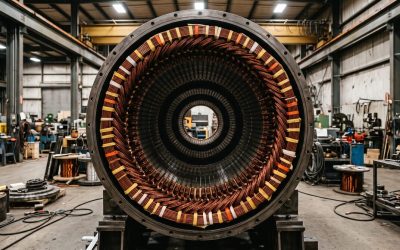
Thermal class describes the materials; the impregnation process determines whether those materials reach their potential. Vacuum pressure impregnation, or VPI, draws air and moisture out of a wound coil under vacuum, then forces resin into every void under pressure. The result is a winding that is nearly solid—mechanically locked against vibration, sealed against contamination, and, critically, far better at conducting heat away from the conductors.
That improved heat transfer is the quiet payoff. By eliminating the air pockets that act as thermal insulation in reverse, a well-executed VPI or resin-rich system lowers the winding’s operating temperature for the same load. Through the lens of the 10-degree rule, every degree of reduction extends life. A thorough impregnation process can be the difference between a winding that barely meets its class and one that runs comfortably within it for years.
The Aging Mechanism, and Why It Is Gradual
Insulation failure is rarely a sudden event. Government-compiled engineering research traces the principle back nearly a century, noting that the rate of thermal deterioration follows the Arrhenius chemical-rate equation—a slow, compounding chemical breakdown rather than an abrupt break. The insulation gradually loses its dielectric strength until, one day, it can no longer withstand the applied voltage and the winding shorts. Because the decline is invisible until the final failure, the temptation to ignore thermal margin is strong, and the consequences arrive years later when the motor dies early.
Why Process Discipline Decides the Outcome
A motor’s nameplate may read Class F, but if the impregnation was rushed, the resin under-applied, or the curing cycle cut short, the real-world thermal performance falls short of the rating. The decline is silent, and it stacks with any damage already present in the core—which is why insulation quality and [PLACEHOLDER: Stator Core Loss and Lamination Integrity: The Hidden Efficiency Killer in Motor Rewinds] are best treated as parts of the same reliability problem. The same is true for rebuilt DC machines, where [PLACEHOLDER: Why Commutator DC Motors Still Dominate Heavy Industry], and the rebuilt armature deserves the same insulation discipline as a new winding.
For manufacturers and repair shops, the takeaway is that insulation longevity is built, not bought. The right thermal-class materials, applied through a controlled impregnation and curing process, turn a motor’s heat budget into years of additional service. Skipping that discipline spends the budget down to nothing—invisibly—until the machine fails ahead of schedule.
Why Rising Loads Make This Urgent
The thermal-class conversation has new urgency because the demands placed on industrial motors are climbing. Operations running longer shifts, pushing equipment toward its service factor, and packing more power into smaller frames all drive winding temperatures upward. A motor specified comfortably a decade ago may now run closer to its thermal ceiling than its original designers intended, quietly eroding the margin that protected its insulation.
Higher ambient temperatures compound the problem. Insulation classes are referenced to a 40°C ambient, and every degree the surrounding air rises above that baseline subtracts directly from the winding’s allowable temperature rise. A motor installed in a hot, poorly ventilated space—common in dense industrial environments—loses thermal headroom before it even starts working. In these conditions, choosing a higher thermal class or a superior impregnation system is not gold-plating; it is the difference between a motor that survives its environment and one that does not.
This is where upgrading during a rebuild pays off. When a motor is already torn down for rewinding, stepping up the insulation system or improving the impregnation process adds modest cost while buying substantial additional life. Treating each rebuild as an opportunity to bank thermal margin, rather than simply restoring the original specification, is one of the highest-return decisions a repair program can make.
CAM Innovation: Engineering Custom Solutions for Motor Manufacturers and Repair Shops
CAM Innovation builds the coil manufacturing, pressing, and curing-support equipment that helps shops execute disciplined insulation and impregnation processes. Consistent, controlled processing is what turns a thermal-class rating into real-world motor longevity.
Our Capabilities Include:
- DC Motor Equipment — Commutator repair machines, mica undercutters, TIG welders, and armature handling systems built for heavy-duty service
- Coil Manufacturing Equipment — Forming, taping, pressing, and winding systems for precision coil production
Ready to strengthen your operation? Contact CAM Innovation to discuss custom equipment and service solutions for your facility.
Frequently Asked Questions
What is the 10-degree rule for motor insulation?
It is a consequence of the Arrhenius relationship: for every 10°C a winding runs above its insulation’s rated temperature, the insulation’s life is roughly cut in half. Run a motor 20°C hot and its life drops to a quarter, so a machine expected to last twenty years can fail in five.
What does insulation thermal class mean?
Thermal classes such as A, B, F, and H define the maximum winding temperature an insulation system can endure continuously while delivering a standard service life. Class F is rated to 155°C and is the most common today; Class H is rated to 180°C. The class is essentially a budget for heat the winding can absorb before its life begins to collapse.
How do VPI and resin systems extend motor life?
Vacuum pressure impregnation draws air and moisture out of a wound coil, then forces resin into every void. The result is a winding that is mechanically locked against vibration, sealed against contamination, and far better at conducting heat away from the conductors. That improved heat transfer lowers the operating temperature for a given load, and through the 10-degree rule, every degree of reduction extends life.
Is it worth upgrading insulation class during a rebuild?
Often, yes. When a motor is already torn down, stepping up the insulation system or improving the impregnation process adds modest cost while buying substantial additional life, especially as rising loads and hot ambient environments eat into thermal margin. Treating each rebuild as a chance to bank thermal margin is one of the highest-return decisions a repair program can make.
Works Cited
Tallerico, Thomas, et al. “Initial Motor Winding Insulation Lifetime Experimental Results for Electric Aircraft Applications.” NASA Technical Reports Server, NASA Glenn Research Center, ntrs.nasa.gov/api/citations/20240007451/downloads/Winding Lifetime Testing V4.pdf. Accessed 14 June 2026.
“DC Electric Motors: Topics by Science.gov.” Science.gov, U.S. Department of Energy Office of Scientific and Technical Information, www.science.gov/topicpages/d/dc+electric+motors. Accessed 14 June 2026.