Department of Energy guidance on motor systems makes a point that energy-savings talk tends to bury. Adjustable speed drives are often installed to improve control over the production process rather than to cut the power bill. Coil winding is a clean example. AC vector drive coil winders exist because winding speed needs to be a variable, not a setting.
The comparison is process against process, not brand against brand.
What the gearbox actually limits
A mechanical gearbox winder offers a fixed range of speeds. The operator picks the closest available step and works around it.
CAM’s winders use AC motors with vector drives, which makes speed selection continuously variable rather than stepped. On paper that sounds minor. On the floor it changes three things.
Large-section strip and small-gauge wire want different speeds, and a stepped machine forces a compromise on one of them. Starting a coil and finishing a coil want different speeds. First turns set the pack. Last turns carry the most accumulated tension. An operator learning the job wants a slow speed that a gearbox may not offer between its steps.
Control layout follows the drive
Vector drive machines put the setup in the control system rather than in the operator’s hands. CAM’s loop winders place operator controls in a freestanding pedestal console. Emergency stop, spindle rotation speed, and spindle direction all live there. A pre-set counter automatically stops winder rotation when the programmed revolution count is reached.
On the rotor coil side, the drive arrangement is described in more detail. The AC vector drive winder uses a heavy-duty welded frame, gearbox, gear belt, and spindle in bearings. It rotates in either direction. Operator controls sit on a swing arm that adjusts for the operator. Automatic tension control is set through a touch screen console, where recipes for multiple coil types can be run and monitored.
Recipes are the practical difference. A stepped machine stores a setting in someone’s memory. A recipe stores it in the machine.
Tension control is the part that cannot be retrofitted cheaply
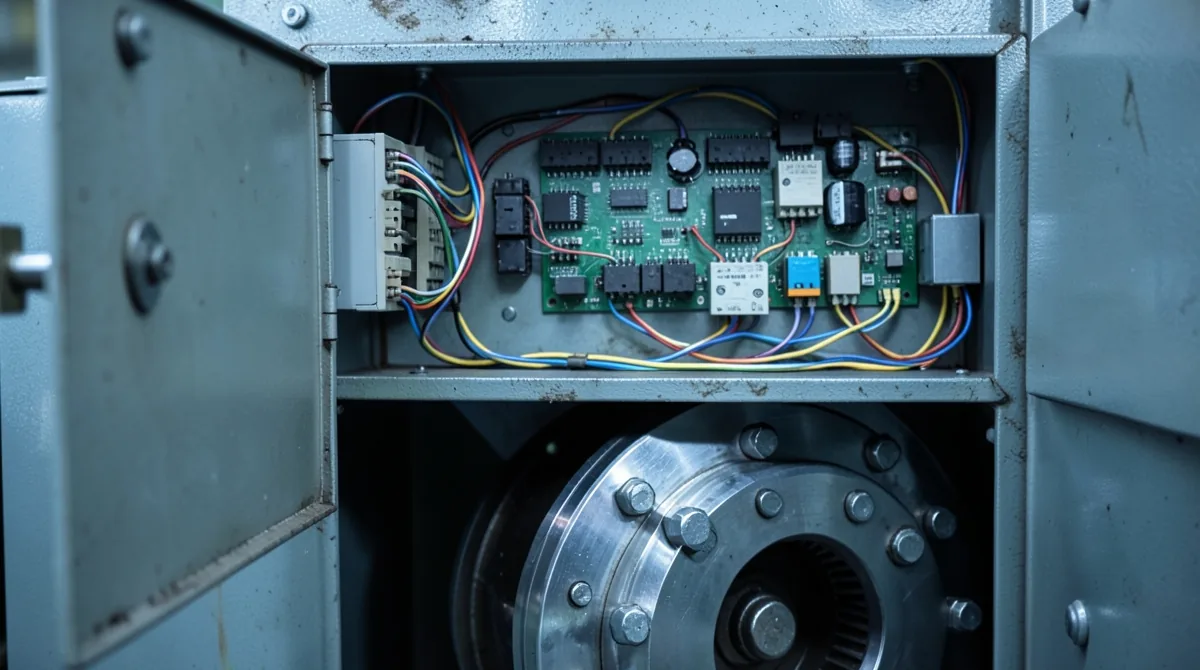
The rotor coil system uses automatic constant tension control that holds tension steady as wire velocity changes, with brake torque under PLC control to maintain equilibrium. Back bending of the wire, so it lies flat and straight, is pre-formed as part of that closed loop tension control system.
A closed loop only works when the drive can respond continuously. This is the technical reason vector drive and tension control tend to arrive together rather than as separate upgrades.
Guarding is a specification decision, not an afterthought
OSHA’s general machine guarding standard, 29 CFR 1910.212, requires one or more methods of guarding to protect operators from hazards including the point of operation, ingoing nip points, and rotating parts. A winder has all three by definition.
CAM’s loop winders can be prewired for light curtain or safety mat integration, with the light curtains and safety mats supplied separately. The rotor coil system takes a different approach at one station. A safety floor mat sits between the traversing unit and the winder. Stepping on that mat limits winder speed to 3 RPM.
Speed limiting rather than stopping is only possible on a drive that can hold a controlled low speed under load. A stepped gearbox cannot do it.
Loading is handled the same way. The dereeler shaft on the rotor coil system sits in easy-to-load safety chucks. They open only in the home position, where the top half slides back so the shaft and wire spool drop in. Restricting chuck opening to one position is what makes crane loading workable.
Where this leaves a shop choosing between the two
A gearbox winder is a simpler machine with fewer electronics. For a shop winding one part family at one speed, that simplicity has real value.
The case for AC vector drive coil winders comes down to part mix and workforce. Multiple coil types, varying wire sizes, changing operators, or a plan to add tension control later all point the same direction. So does any requirement that a specific setup be reproduced next quarter by someone who was not there this quarter.
Frequently Asked Questions About AC Vector Drive Coil Winders
01What is an AC vector drive coil winder?
An AC vector drive coil winder uses an AC motor controlled by a vector drive rather than a mechanical gearbox. Speed selection is continuously variable rather than stepped. CAM Innovation builds loop winders and rotor coil winding systems on this arrangement from Hanover, Pennsylvania.
02What is the difference between a vector drive winder and a gearbox winder?
A gearbox winder offers a fixed range of speeds, so the operator picks the closest available step. A vector drive winder varies speed continuously across that range. The practical gain shows up with mixed wire sizes, with operators still learning, and with setups that must be repeated later.
03Do coil winders come with light curtains and safety mats?
CAM Innovation’s loop winders can be prewired for light curtain or safety mat integration, though the light curtains and safety mats themselves are supplied separately. Specifying that prewiring at order is much simpler than retrofitting guarding integration onto a machine already running on the floor.
04How does a winder stop at the right turn count?
A pre-set counter stops winder rotation automatically once the programmed number of revolutions is reached, so turn count no longer depends on an operator keeping tally. On CAM Innovation’s loop winders, operator controls sit in a freestanding pedestal console covering stop, speed, and direction.
05Can one winder hold settings for more than one coil type?
Yes. On CAM Innovation’s rotor coil winding system, automatic tension control is set through a touch screen console, and recipes for multiple coil types can be run and monitored. A recipe keeps the setup in the machine rather than in one operator’s memory.
CAM Innovation: Custom Machinery for Motor and Coil Manufacturing
CAM Innovation builds custom automated machinery for the electric motor and coil manufacturing industry from Hanover, Pennsylvania. Every machine is Made in USA and designed around the process the customer actually runs.
Our Equipment Includes:
- Loop Winders — AC vector drive winders with automatic turn count and continuously variable speed
- Coil Manufacturing Equipment — Taping, forming, pressing, and winding systems for AC and DC form coils
Automating a process? Contact CAM Innovation to discuss your part, your volume, and your shop layout.
Works Cited
- Occupational Safety and Health Administration. “1910.212 — General Requirements for All Machines.” U.S. Department of Labor, 2026, https://www.osha.gov/laws-regs/regulations/standardnumber/1910/1910.212.
- U.S. Department of Energy, Advanced Manufacturing Office. “Magnetically Coupled Adjustable Speed Motor Drives.” Energy.gov, Nov. 2012, https://www.energy.gov/sites/prod/files/2014/04/f15/motor_tip_sheet13.pdf.
- This article is general industry information and is not a substitute for manufacturer operating documentation, OSHA guidance, or a qualified engineer’s assessment of your specific equipment.