CAM Innovation — custom automated machinery for the heavy-duty electric motor repair industry, proudly made in the USA in Hanover, Pennsylvania.
The biggest electric motors in America rarely make headlines, but they decide whether ore gets crushed and steel gets rolled. In 2026, the industries that run them are busy enough to keep those motors turning — and to keep rebuilding them as they wear. Mining is a $112 billion business: the U.S. Geological Survey reports the value of domestic nonfuel mineral production rose 5.6% to about $112 billion in 2025, and that mineral-reliant industries contributed $4.09 trillion to the economy, more than one-eighth of U.S. output. Behind those numbers are draglines, crushers, hoists, and grinding mills, all driven by heavy motors that run nearly around the clock.
Mining: Critical Minerals Keep the Motors Loaded
The mining story in 2026 is inseparable from critical minerals. The USGS notes the United States remains dependent on imports — with China the primary source for 14 of the 33 critical minerals the country most relies on importing — a vulnerability now driving new investment in domestic extraction and processing. More domestic mining means more duty on the enormous motors that power it. A mine hoist or a semi-autogenous grinding mill motor can weigh tons and cost a fortune to replace; when demand is high, taking one offline for weeks to await a new unit simply is not an option. Operators rebuild instead, restoring armatures and windings to keep production flowing. The stronger the push to mine and process minerals at home, the harder those motors work — and the more often they cycle through the repair shop.
Steel and Mills: Bottoming Out and Turning Up
Primary metals tell a parallel story. The World Steel Association’s Short Range Outlook, released in April 2026, forecasts global steel demand rising 0.3% in 2026 to 1,724 million tonnes, with a stronger 2.2% gain expected in 2027 — and U.S. steel demand growing an above-average 1.7% in 2026. After years of stagnation, in other words, steel is bottoming out and beginning to climb. Rolling mills, coilers, and processing lines run on large DC mill motors prized for their precise speed and torque control, many of them decades old and irreplaceable at any reasonable cost or timeline. As mills lift utilization to meet recovering demand, keeping those motors healthy becomes mission-critical. A single failed mill motor can idle an entire line, so scheduled rebuilds and fast turnarounds are the difference between hitting output targets and missing them.
Paper, Oil, and the Rest of Heavy Industry
The pattern extends across the heavy-industrial base. Paper mills run big motors on their machine drives and refiners; oil and gas facilities depend on motor-driven pumps and compressors; and every one of these operations faces the same 2026 reality: replacement motors are expensive and slow to source, while a well-executed rebuild returns a proven machine to service quickly. The common thread is that these are not disposable motors. They are large, specialized, capital-intensive assets built to run for decades — which is exactly why rebuilding them, again and again, is the rational choice rather than a stopgap.
The Case for Rebuilding Runs Deeper in 2026
The reasons heavy industry leans on repair this year are the same ones reshaping motor decisions economy-wide: record copper prices, long lead times for new equipment, and mounting efficiency pressure — the full picture laid out in Repair or Replace? The 2026 Outlook for Heavy-Industry Electric Motors. For the largest DC motors, those forces are amplified. The copper content of a mine-duty or mill motor is enormous, so a new build is punishingly expensive when copper trades near record highs. The physical size makes shipping and installation a major project in its own right. And the custom, often obsolete designs mean a new equivalent may not even be available off the shelf. Rebuilding sidesteps all three problems at once.
Precision Is What Makes It Work
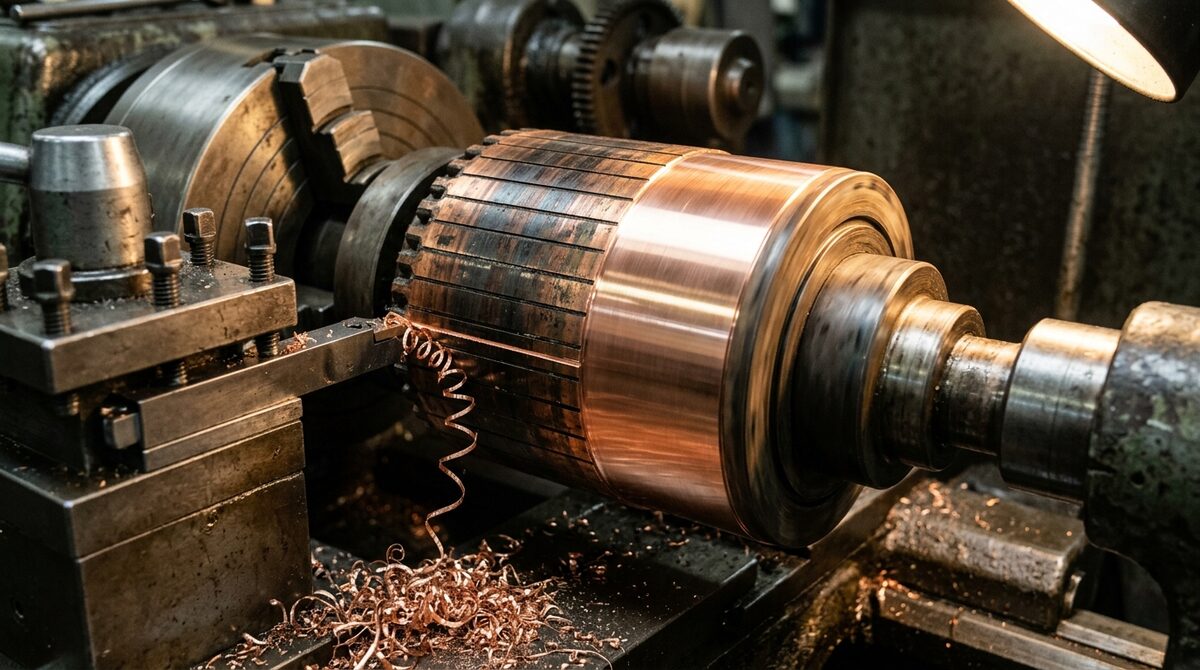
Rebuilding a mine hoist or mill motor is heavy, exacting work. Armatures must be stripped, rewound, welded, banded, and seasoned; commutators must be undercut and slotted to precise tolerances; and the finished machine must be balanced and tested to perform under crushing loads. The larger the motor, the higher the stakes — and the greater the payoff from doing the work on automated, purpose-built equipment rather than by hand. Speed matters just as much, because the freight networks that move this ore and steel are tightening at the same time, as covered in Aging Rail and Transit Fleets Are Driving Traction Motor Overhauls in 2026. A motor sitting in the shop is production standing still, so turnaround time is money.
The Outlook for the Rest of 2026
Mining is expanding, steel is recovering, and the motors that power both are aging assets too valuable and too hard to replace to simply throw away. That combination points to sustained, resilient demand for heavy-motor rebuilds through the rest of 2026 and beyond. For the shops doing the work, the winners will be those with the equipment and process discipline to return the biggest, most critical motors to service fast — because in mining and metals, downtime is measured in lost tons, not just lost hours.
CAM Innovation: Built for the Biggest Motors
CAM Innovation’s welding and motor-handling equipment help mining and metals repair shops rebuild the largest, most critical DC motors safely and consistently — engineered and made in the USA.
Our Solutions Include:
- Automatic TIG Welders — Repeatable, high-quality armature welds that process in minutes what once took hours by hand
- Motor Assembly & Disassembly Machines — Safely assemble and disassemble large motors with single-operator control and no component damage
Ready to rebuild your heavy motors faster? Contact CAM Innovation to design a solution for your operation.
Works Cited
- “Value of U.S. Mineral Production Rose Last Year, Driven by Precious Metals Prices.” U.S. Geological Survey, 6 Feb. 2026, www.usgs.gov/news/national-news-release/value-us-mineral-production-rose-last-year-driven-precious-metals-prices. Accessed 22 July 2026.
- “worldsteel Short Range Outlook April 2026.” World Steel Association, 14 Apr. 2026, worldsteel.org/media/press-releases/2026/worldsteel-short-range-outlook-april-2026/. Accessed 22 July 2026.