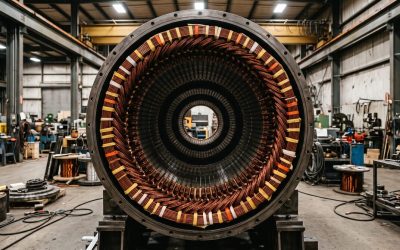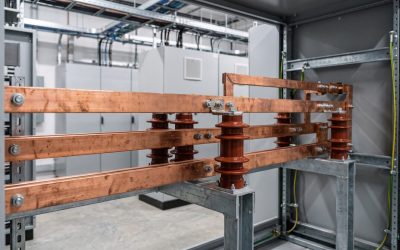
The COMEX copper price averaged a record $4.80 per pound during 2025, a 14 percent jump from $4.22 the year before, according to the U.S. Geological Survey. That single number has changed the economics of a scrapped coil.
For a coil shop, copper is not a line item. It is most of the bill of materials. Copper price pressure on coil shops shows up first in quoting, then in scrap tolerance, and eventually in equipment decisions.
Supply is tighter than the price alone suggests
The USGS reports several conditions stacking up at once. U.S. mine production fell about 5 percent in 2025 to roughly 1.0 million tons, hurt by concentrator shutdowns and lower ore grades. Domestic refined output dropped an estimated 9 percent while both primary smelters ran planned maintenance. Net import reliance climbed to 57 percent of apparent consumption, up from 45 percent the prior year.
Copper was added to the U.S. critical minerals list in November 2025. Refined copper imports nearly doubled as buyers built inventory ahead of tariff decisions. Producer prices have tracked the same direction, with Bureau of Labor Statistics data showing copper wire and cable indexes climbing sharply through late 2025 and into 2026.
What that does to a scrapped coil
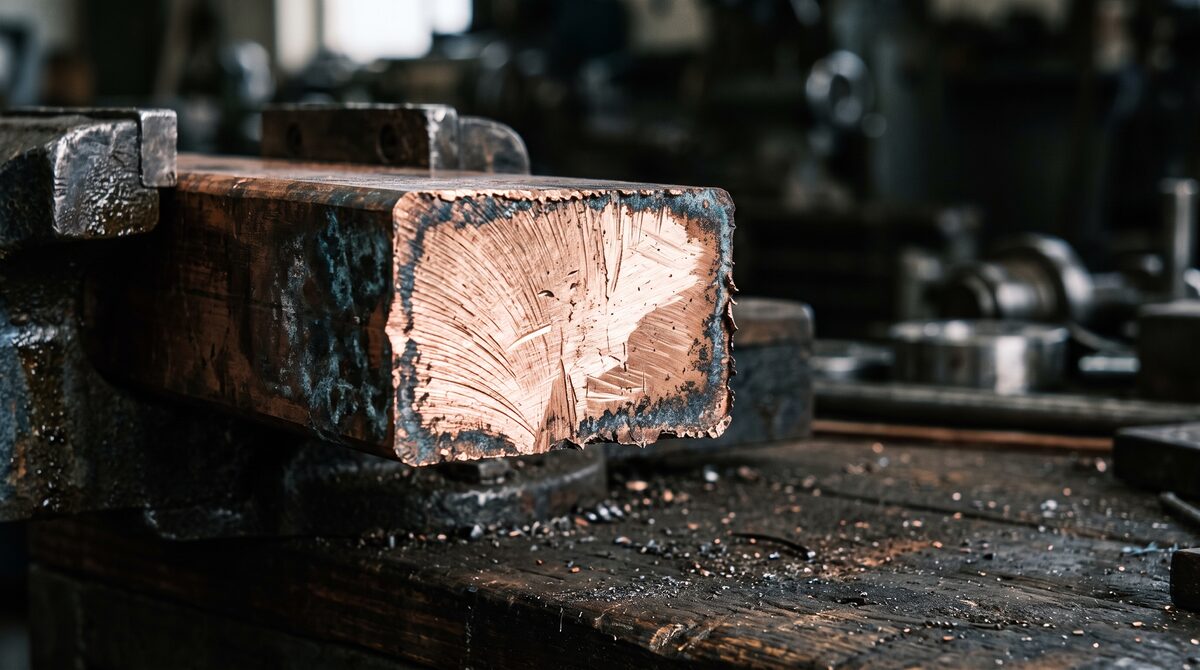
A form coil that comes out of the press with the wrong knuckle angle used to represent an afternoon of rework. Today it represents an afternoon of rework plus materially more copper at risk. Shops that never tracked coil-level scrap are starting to.
Three areas absorb most of the loss:
- Cut-to-length accuracy. Strip cut long is money left on the floor. Strip cut short is a full remake.
- Forming repeatability. A geometry that walks across a run produces coils that fit the slot on Monday and fight it on Thursday.
- Taping overlap. Over-taping wastes tape and builds dimension the slot cannot accept. Under-taping fails inspection.
None of these are new problems. Higher copper prices simply moved them up the priority list.
Quoting has changed too
Coil shops that quoted on a fixed material price are moving toward shorter quote validity windows and indexed material clauses. Buyers are pushing back. That negotiation is easier for a shop that can point to a documented scrap rate and a repeatable process than for one relying on operator skill alone.
At the same time, rewind volume is climbing as utilities extend the life of existing generation rather than waiting years for new turbines. More work at tighter material margins is a difficult combination to run by hand.
Where automation enters the conversation
Copper use in the U.S. breaks down to 23 percent electrical and electronic products and 7 percent industrial machinery and equipment, per the Copper Development Association figures published by the USGS. Coil shops sit inside both categories, and they compete for the same strip everyone else is buying.
Shops responding to that pressure tend to look at the front of the process first — dereeling, cut-to-length, and edgewinding — because yield lost there cannot be recovered downstream. Forming and taping follow, since both determine whether a coil passes dimensional inspection the first time. The same logic is showing up in bus bar and harness work, where insulating material and copper are both getting more expensive.
CAM Innovation: Custom Machinery for Motor and Coil Manufacturing
CAM Innovation builds custom automated machinery for the electric motor and coil manufacturing industry from Hanover, Pennsylvania. Every machine is Made in USA and designed around the process the customer actually runs.
Our Equipment Includes:
- Coil Manufacturing Equipment — Taping, forming, pressing, and winding systems for AC and DC form coils
- Automatic Coil Taping Machines — SA1000 and SA2000 systems for controlled tape overlap
Automating a process?
Contact CAM Innovation to discuss your part, your volume, and your shop layout.
Works Cited
- U.S. Bureau of Labor Statistics. “Producer Price Indexes.” U.S. Department of Labor, 2026, https://www.bls.gov/ppi/.
- U.S. Geological Survey. “Copper.” Mineral Commodity Summaries 2026, U.S. Department of the Interior, Feb. 2026, https://pubs.usgs.gov/periodicals/mcs2026/mcs2026-copper.pdf.