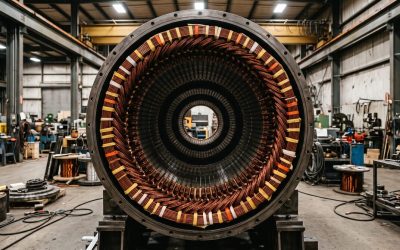
Skilled Labor Shortage Pushes DC Motor Manufacturers Toward Automated Brazing Systems
CAM Innovation: Precision Equipment for Heavy Industry
Direct current motor manufacturers and repair facilities face an acute workforce challenge that is reshaping how commutators get built. The brazed copper joints connecting commutator bars to risers and armature coil leads have traditionally been the domain of highly skilled hand brazers—craftsmen whose ranks are thinning fast as the broader welding and brazing trades face an unprecedented retirement wave.
The American Welding Society’s workforce projections frame the scale of the problem. According to AWS workforce data, the United States will need more than 330,000 new welding professionals by 2028, with roughly 82,500 job openings annually through that period. The average welder is approximately 55 years old, and a substantial share of the workforce reached retirement eligibility by late 2025. For every five experienced welders and brazers leaving the trade, only about two new workers are entering. For DC motor manufacturers and rebuilders, the math is unforgiving.
Why Brazing Matters for DC Motor Performance
The commutator is arguably the most stress-loaded component in a DC motor. Each copper segment must carry full armature current, withstand mechanical contact from carbon brushes, and survive thermal cycling and centrifugal forces at operating speeds. The brazed joints between commutator risers and armature coil leads cannot fail. A single bad joint causes localized overheating, arcing, and eventually catastrophic motor failure that can take a locomotive, mill stand, or mine hoist out of service for days—at costs that dwarf the original repair.
Hand brazing these joints requires consistent flame placement, precise filler metal feeding, and tight temperature control across hundreds of joints on a single armature. When skilled brazers are unavailable, defect rates climb, scrap increases, and rework eats into already thin margins on rebuild contracts. For context on the broader equipment investment surge driving these changes across the sector, see Why Aging Industrial DC Motor Fleets Are Driving an Equipment Investment Surge in 2026.
Induction Brazing Removes the Skill Bottleneck
Automated induction brazing systems are emerging as the most practical response. Induction brazing uses electromagnetic fields to heat workpieces directly and precisely, with frequencies tuned to the specific copper alloys and joint geometries involved in commutator construction. The process is faster than torch brazing, more controlled than furnace brazing, and produces repeatable results that do not depend on operator judgment for each individual joint.
The induction brazing systems market reflects this manufacturing shift. Industry analysts project the segment to grow from roughly $422 million in 2026 toward $723 million by 2032, driven largely by manufacturers seeking precision joining that requires fewer skilled operators per shift. For DC motor producers and rebuilders, the value proposition is direct: an induction brazing station with programmable parameters can be operated by a technician with weeks of training rather than years, while delivering joint quality that meets or exceeds traditional torch work.
The Energy and Cost Equation
Beyond labor, induction systems address operational cost pressures hitting motor shops nationwide. The U.S. Department of Energy’s Motor System Market Assessment documents that machine driven processes account for approximately 68 percent of electricity use in U.S. manufacturing, putting energy efficiency at the center of competitive positioning. Induction brazing generates heat directly within the workpiece rather than heating a torch and the surrounding environment, cutting energy consumption per joint substantially compared with gas-flame methods. Cleaner heating also reduces ventilation requirements and consumable costs—flux and filler metal usage drops when the process is tightly controlled.
The geographic distribution of DC motor repair work makes these advantages particularly relevant. Many regional shops serving freight railroads, transit agencies, and heavy industry operate older facilities where workforce constraints and energy costs both apply pressure simultaneously. Investing in induction brazing equipment is increasingly framed not as a luxury upgrade but as a survival decision.
Implications for the Broader DC Motor Rebuild Industry
The shift toward automated brazing connects directly to a broader pattern of equipment investment across the DC motor sector. Armature banding, commutator slot cutting, and seasoning processes are all moving toward programmable, semi-automated platforms for the same reasons. Equipment consolidation—where a single machine handles multiple processes—reduces footprint and handling time while letting smaller crews maintain output.
The aging traction motor fleet that depends on this work continues to grow, as covered in How a $140 Billion Transit Backlog Is Driving DC Motor Armature Banding Equipment Demand. Operators of legacy locomotives, mill drives, and mine hoists need rebuilds completed faster than ever, and the shops capable of delivering that work are the ones investing in equipment that compensates for the skilled labor no longer available at any price.
CAM Innovation: Your Partner in DC Motor Manufacturing and Repair
At CAM Innovation, we build precision equipment for DC motor manufacturers and repair facilities navigating the workforce and quality pressures defining the industry today. Our brazing solutions are engineered for the realities of commutator construction in railroad, mining, steel, and heavy industrial applications.
Our Services Include:
- Brazing Machine Equipment – Induction brazing systems designed for consistent, repeatable commutator and connection joining without dependence on scarce hand-brazing expertise
- DC Motor Equipment – Complete equipment lines for armature winding, commutator preparation, banding, and motor assembly
Ready to Modernize Your Brazing Operation? Contact CAM Innovation
Works Cited
“Welding Workforce Data.” American Welding Society, weldingworkforcedata.com. Accessed 26 May 2026.
“U.S. DOE Motor System Market Assessment.” Advanced Materials and Manufacturing Technologies Office, U.S. Department of Energy, www.energy.gov/cmei/ammto/us-doe-motor-system-market-assessment. Accessed 26 May 2026.