Aging Motor Repair Shop Equipment Becomes a Bottleneck as Industrial Demand Surges

CAM Innovation: Custom Automated Machinery for the Electric Motor Industry
While headlines focus on greenfield factories and battery plants, a quieter capacity story is unfolding inside the nation’s electric motor repair shops. With reshoring driving record industrial output and aging plants pushing existing motors past their intended service life, repair centers are absorbing surging volume on equipment that, in many cases, predates the customers it now serves. The bottleneck is not a shortage of work — it is the condition of the machinery used to do the work, and the increasingly thin layer of expertise still around to keep it running.
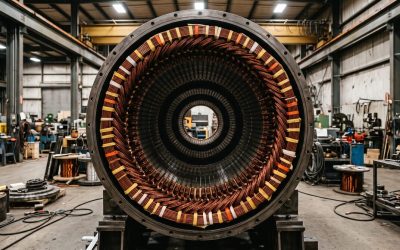
The numbers behind the repair market are large and largely overlooked. Industry analysis cited by the U.S. Department of Energy in its motor systems work has historically estimated roughly 12.4 million electric motors over one horsepower in service across US manufacturing facilities, with motors consuming the majority of industrial electricity in many sectors. The Consortium for Energy Efficiency has reported that of approximately 2.9 million motor failures each year, only about 600,000 are replaced — meaning the bulk are rewound and returned to service by independent repair centers and in-house maintenance shops. Each of those rewinds requires specialty equipment: commutator undercutters, mica banding lathes, armature winders, coil taping machines, and high-precision presses. Without that equipment in working order, the rewind cannot happen at the cost or quality the customer expects, and the customer either pays a premium, delays the repair, or replaces the motor at three to five times the cost.
DC Motor Repair Equipment Matters More Than the Headlines Suggest
The narrative around motor manufacturing in 2026 tilts heavily toward EV traction motors and permanent-magnet synchronous machines, but the installed base of US industrial DC motors and AC induction motors is enormous and aging in place. Steel mills, paper plants, mining operations, military depots, rail systems, and large municipal water utilities run mission-critical DC motors that cannot be cost-effectively replaced with newer designs without redesigning the surrounding system. When those motors fail, the repair shop holds the only realistic path back to production — and the equipment in that shop determines turnaround time. (As discussed in America’s $1.66 Trillion Reshoring Wave Is Stress-Testing Motor Manufacturing Equipment Service Capacity, this dynamic plays out across the broader motor production ecosystem, not just the rewind sector.)
The challenge is that much of the specialty repair equipment in use today was built decades ago. Commutator repair lathes, automatic mica undercutters, banding machines, armature seasoning systems, and TIG welders for commutator work have long service lives, but they require ongoing parts support, alignment, and operator training to hold the tolerances modern motor specifications demand. As the original technicians who set up these machines retire, the institutional knowledge required to keep them producing in-spec work walks out the door with them. A shop that loses two senior commutator-machine operators in the same year can find itself with adequate equipment and no realistic ability to use it at full capability — a gap that is invisible on a balance sheet and obvious on a production schedule.
The repair sector also carries a unique service complexity that fresh-build motor lines do not. Repair shops do not control the design, material specifications, or service history of the motors that arrive on their docks. Every job is, to some degree, a custom engineering exercise, with the equipment expected to handle a wide spread of motor sizes, conductor configurations, insulation systems, and customer specifications. That variability is exactly the kind of work where equipment-specific expertise matters most, and exactly the kind of work that suffers most when that expertise is in short supply.
Efficiency Standards Are Reshaping the Rewind Decision
Federal and international efficiency standards are pushing repair shops toward higher-quality work whether they want to be there or not. Research from the American Council for an Energy-Efficient Economy has documented that motors account on average for about two-thirds of all electricity used in manufacturing, with motor load fractions reaching 90 percent or more in paper, petroleum refining, rubber, and wood products facilities. As IE3, IE4, and now IE5 ultra-premium efficiency standards roll forward globally and through US compliance pathways, every rewind decision becomes a calculation: rebuild to original specifications, or rebuild to a higher-efficiency design that requires tighter winding tolerances, better insulation systems, more uniform commutator surfaces, and more precise mechanical work overall.
That calculation puts pressure on the equipment itself. A coil taping machine running at decades-old precision may have been adequate for a 1990s motor rebuild but cannot reliably deliver the consistency a modern high-efficiency rewind requires. The same applies to mica undercutting depth control, armature banding tension, commutator turning concentricity, and the dimensional accuracy of fixturing throughout the shop. Aging machinery does not simply slow throughput — it caps the quality ceiling of what a repair shop can deliver, and in 2026 that ceiling is increasingly below what large industrial customers are now specifying.
The energy economics also tilt the math. When a customer is comparing the cost of a higher-efficiency rewind against the cost of a new motor, the rewind only wins if the shop can credibly hit the higher efficiency number. A shop that cannot do that begins losing rewind work to either replacement or to competitors with newer equipment — and once a customer relationship migrates away, it tends to stay away. The window to make rewind capability decisions is now, while customers are still actively choosing between repair and replacement.
Modernization Without Wholesale Replacement
The good news for shop owners is that modernization rarely requires throwing out the entire production floor. Many existing machines can be retrofitted with updated controls, drive systems, sensors, and tooling — provided the OEM still maintains the engineering documentation and parts inventory needed to do the work. This is where service relationships become decisive. OEMs that retain decades of technical records can keep older equipment producing at competitive specifications well past what a balance sheet would predict, while shops working with vendors who lost or never kept that documentation face full replacement decisions at vastly higher capital cost.
For shops weighing capital allocation in 2026, the question is not whether to modernize, but how to sequence it. Bottleneck stations — typically coil winding, taping, and final assembly — usually deliver the strongest payback when upgraded first, because every minute saved at the bottleneck flows through to total shop throughput. Specialty stations like mica undercutters and TIG welders for commutator work generally retrofit well rather than requiring full replacement, with new controls extending useful life by another decade or more. Banding machines, armature seasoning ovens, and rotation stands are also strong retrofit candidates, since the underlying mechanical structure tends to outlast the original control system by a comfortable margin.
A reasonable sequencing plan for most shops looks something like this: first, modernize the controls and drives on the highest-throughput stations to recover capacity and improve quality; second, retrofit specialty stations to lift the quality ceiling toward IE4 and IE5 work; third, replace any remaining equipment whose age, parts availability, or precision limits cannot be addressed through retrofit. Each stage delivers measurable payback before the next is funded, which is the only realistic way most independent repair shops can finance modernization out of operating cash flow.
Why OEM Application Support Is the Quiet Advantage
The constraint repair shops cannot solve internally is application engineering for changing customer requirements. When a longtime industrial customer brings in a 1970s-vintage DC motor that now needs to drive an Industry 4.0–instrumented system, the rewind specification has to integrate cleanly with new sensors, drives, monitoring systems, and sometimes regenerative braking circuits the original motor was never designed to support. OEM application support — the kind that comes from engineers who actually design rebuild equipment — gives repair shops a practical path through these specification questions without taking floor technicians off production work to puzzle through one-off problems. The same support model also matters when shops face the inevitable workforce question covered in Skilled Technician Shortage Forces Motor Builders to Lean Harder on OEM Field Support.
OEM support also matters for parts. Spare-part availability for specialty repair equipment is heavily dependent on whether the original manufacturer is still actively producing the line, still stocking long-tail components, and still able to manufacture obsolete parts to spec when needed. Shops that work with OEMs that maintain technical records spanning decades and keep meaningful spare-parts inventory routinely report next-business-day parts shipments on equipment built thirty or forty years ago — a turnaround that simply does not exist when the original OEM has exited the business or stopped supporting older models.
The motor repair industry has always run on equipment, expertise, and trust. In 2026, with industrial demand surging and the original generation of repair specialists retiring, all three are in shorter supply at exactly the moment customers need more from them. The shops that come out of this decade in a stronger competitive position will be the ones that treated their equipment OEMs as long-term technical partners rather than vendors of last resort.
CAM Innovation: Service and Support for Motor Manufacturing
CAM Innovation has built specialized equipment for electric motor manufacturers and repair shops for over a century, supporting both new motor production and the rebuild market with custom-engineered machinery and direct OEM service. Our Hanover, PA operations include the same engineering and service teams that designed many of the machines still running on shop floors across North America today.
Our Services Include:
- CAM Service & Support — Application engineering, installation, operator training, spare parts, and 365-day emergency assistance from CAM’s own service team
- DC Motor Equipment — Commutator repair machines, mica undercutters, banding machines, armature stands, and TIG welders for repair and rebuild operations
Modernizing Your Repair Shop? Contact CAM Innovation to discuss equipment upgrades, application support, or emergency service for your motor repair operation.
Works Cited
“Energy Efficiency in Electric Motor Systems.” American Council for an Energy-Efficient Economy, ACEEE Report Number IE952, Apr. 1995, www.aceee.org/sites/default/files/pdfs/ie952.pdf. Accessed 30 Apr. 2026.
“Motor Systems.” Office of Energy Efficiency and Renewable Energy, U.S. Department of Energy, www.energy.gov/cmei/ito/motor-systems. Accessed 30 Apr. 2026.