Improving AC Motor Manufacturing with CAM Innovation’s Lamination Press and Welding Positioner
In the demanding world of electric motor manufacturing, precision, safety, and efficiency are paramount concerns. CAM Innovation’s Lamination Press and Welding Positioner represents a significant advancement in addressing these challenges, offering motor manufacturers a solution that transforms the lamination stacking and welding process. This innovative equipment not only improves production outcomes but dramatically enhances operator safety and work comfort.
Revolutionizing Motor Core Assembly
The heart of any AC motor lies in its laminated core structure – a precision assembly of thin metal sheets that form the stator and rotor components. This design is fundamental to motor efficiency, as the laminated structure helps minimize eddy current losses that would otherwise reduce performance and generate excess heat.
The assembly process of these lamination stacks presents significant manufacturing challenges. Proper stacking, alignment, and securing of these components demand specialized equipment that can maintain precise positioning while providing secure holding pressure throughout the welding process.
CAM Innovation’s Lamination Press tackles these challenges head-on with a robust design that prioritizes both precision and operator safety. Built on over a century of engineering expertise, this system represents the culmination of practical field experience combined with advanced manufacturing technology.
Key Features That Drive Performance
The Lamination Press and Welding Positioner incorporates several critical features that set it apart from conventional solutions:
High-Strength Construction
The system features a high-strength welded steel base providing the stability required for precision work. This solid foundation supports:
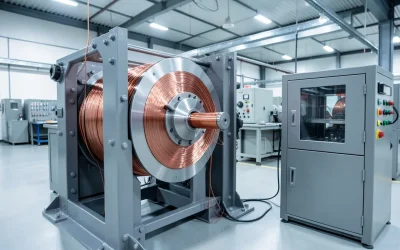
- A welded steel frame and press frame head for rotating the rotor
- Adjustable, precision-machined rotor core fixtures
- A rugged hydraulic press head capable of handling rotors of various lengths
The robust construction ensures that the lamination stack remains perfectly aligned under pressure, critical for achieving optimal magnetic performance in the finished motor.
Multi-Position Capability
The press allows operators to manipulate the workpiece along multiple axes:
- Vertical adjustment to achieve comfortable welding height
- 360-degree rotation under pressure to access all welding points
- 180-degree flip capability for complete end-to-end welding access
This multi-positional functionality dramatically improves access to all areas requiring welding, eliminating awkward positioning and reducing operator fatigue.
Advanced Safety Systems
Safety remains a top priority in the design, with features including:
- Proximity sensors for easy, repeatable positioning
- Interlocked mechanical clips ensuring the core is held firmly before rotation
- Integrated lifting lugs for safe installation and removal of the press head
- Stand-alone operator control pedestal with intuitive push-button interface
These safety features not only protect operators but also help prevent damage to valuable motor components during the manufacturing process.
The Manufacturing Process Transformed
The traditional approach to motor lamination stacking and welding often involves awkward positioning, limited access to welding points, and potential safety risks. CAM Innovation’s system transforms this process into a streamlined, ergonomic operation.
Superior Core Pressure Maintenance
One of the most significant advantages of the Lamination Press is its ability to maintain consistent pressure on the stacked laminations throughout the welding process. This continuous pressure ensures:
- Precise alignment of the individual laminations
- Minimal air gaps between layers
- Optimal magnetic properties in the finished core
- Reduced vibration in the completed motor
According to the National Institute for Occupational Safety and Health, ergonomically designed manufacturing equipment can reduce work-related musculoskeletal disorders significantly – a benefit clearly realized in the design of the Lamination Press.
Enhanced Welding Access
The rotating and flipping capabilities allow welders to maintain optimal positioning throughout the process. This improved access results in:
- Higher quality welds with better penetration
- Reduced welding defects
- Lower operator fatigue
- Faster completion times
- Improved consistency across production runs
The U.S. Department of Energy notes that manufacturing process improvements like these can increase production efficiency by up to 30% in specialized equipment applications.
Simplified Workpiece Handling
After welding is complete, the system simplifies the handling of the finished assembly:
- The core is returned to its upright position
- The detachable press head is removed using the integrated lifting lugs
- The press head is stored on a separate stand
- The finished workpiece is easily lifted out of the press
This streamlined workflow reduces handling damage and improves production flow, further enhancing manufacturing efficiency.
Efficiency Benefits in Motor Manufacturing
Implementing the Lamination Press and Welding Positioner offers motor manufacturers measurable efficiency benefits that directly impact the bottom line.
Production Time Reduction
The system significantly reduces the time required for lamination stacking and welding operations through:
- Faster setup and positioning
- Improved welding access reducing time per weld
- Streamlined workpiece handling
- Less downtime for operator rest breaks due to reduced fatigue
These time savings translate directly to increased throughput and lower labor costs per unit.
Quality Improvements
The precision and consistency provided by the Lamination Press result in measurable quality improvements:
- More precise alignment of laminations improves magnetic properties
- Consistent pressure application reduces variation between assemblies
- Better welding access results in stronger, more reliable welds
- Reduced handling damage preserves the integrity of the stack
Research from the Manufacturing Engineering Society International indicates that purpose-built industrial equipment with proper maintenance can maintain operational efficiency for decades, making systems like the Lamination Press valuable long-term investments.
Worker Safety and Ergonomics
Perhaps the most significant long-term benefit comes from improved operator safety and ergonomics:
- Reduced physical strain from awkward positioning
- Lower risk of repetitive motion injuries
- Decreased exposure to welding fumes through better positioning
- Reduced risk of handling injuries from heavy components
The EPA Sustainable Manufacturing Initiative reports that ergonomic improvements not only reduce injuries but can increase productivity by up to 25% in manufacturing environments.
Advanced Automation Options
For high-volume production environments, CAM Innovation offers an optional automatic welding arm integration. This enhancement takes productivity to the next level by:
- Automating the welding process
- Enabling programmable positioning of both core and weld torch
- Ensuring consistent weld quality across large production runs
- Further reducing operator fatigue in high-volume applications
This automation option represents the perfect bridge between manual craftsmanship and fully automated production, maintaining quality while increasing throughput.
Applications Across Industrial Sectors
The versatility of the Lamination Press and Welding Positioner makes it valuable across numerous industrial applications:
Heavy Manufacturing
In heavy industrial motor manufacturing, the system excels at handling the larger lamination stacks required for high-power applications. Companies in mining equipment, steel production, and large-scale material handling benefit from the robust construction and precision of the press.
Transportation
The transportation sector, including railroad, mass transit, and shipbuilding, relies heavily on specialized electric motors. The Lamination Press provides the precision required for these critical applications, where motor reliability directly impacts safety and operational efficiency.
Energy Generation
Wind power generators and other renewable energy applications demand exceptional motor quality. The consistent lamination stack quality provided by the Lamination Press helps manufacturers meet the rigorous specifications of these growing industries.
Military and Defense
Defense contractors appreciate the combination of robustness and precision offered by the Lamination Press, allowing them to meet the stringent requirements of military specifications while maintaining production efficiency.
The Connection to Manufacturing Efficiency
Modern manufacturing faces constant pressure to improve efficiency while maintaining or enhancing quality. The lamination stacking process represents a critical bottleneck in motor production where manual methods struggle to meet these competing demands.
The Reshoring Initiative reports that motor and generator manufacturing is among the top categories for reshoring activity, with many companies bringing production back to the U.S. This trend increases the importance of efficient, high-quality manufacturing processes that can compete globally while operating under U.S. labor and safety standards.
CAM Innovation’s system addresses this challenge by introducing greater precision and ergonomics without sacrificing the craftsmanship that quality motor production demands. This balance makes it an ideal solution for manufacturers looking to:
- Increase production volume without sacrificing quality
- Reduce workplace injuries and associated costs
- Improve consistency across production runs
- Meet increasingly stringent efficiency requirements
Long-Term Value Proposition
When evaluating manufacturing equipment investments, the long-term value proposition often proves more important than initial acquisition costs. The Lamination Press and Welding Positioner delivers exceptional long-term value through:
Durability and Longevity
Built with high-strength materials and robust engineering, the system is designed to provide decades of reliable service, even in demanding production environments. This longevity spreads the initial investment across thousands of production cycles.
Adaptability to Various Motor Types
The adjustable fixturing and versatile positioning capabilities allow the system to accommodate a wide range of motor sizes and configurations. This adaptability ensures the equipment remains useful even as product lines evolve.
Reduced Workplace Injury Costs
By improving ergonomics and reducing physical strain, the system helps prevent costly workplace injuries that can impact both direct medical costs and productivity. These savings often go unrealized when evaluating equipment investments.
Quality Improvements
The precision and consistency provided by the Lamination Press translate directly to improved motor quality. This quality enhancement flows through to reduced warranty claims, improved customer satisfaction, and stronger market position.
Expert Perspectives on Lamination Technology
Industry experts continue to highlight the importance of precision in motor lamination assembly. According to research from the electric motor manufacturing sector, the stacking process significantly impacts both the magnetic properties and mechanical stability of the finished motor.
The careful alignment and consistent pressure maintained during welding directly influence the motor’s efficiency by minimizing gaps that would otherwise disrupt magnetic flux paths. This attention to detail becomes increasingly important as motor efficiency standards continue to rise globally.
Future Directions in Motor Manufacturing
As electrification expands across industries, motor manufacturers face growing pressure to improve efficiency, reduce size, and enhance reliability. These trends place even greater importance on precision manufacturing processes like those enabled by the Lamination Press.
Future developments may include enhanced integration with digital manufacturing systems, providing real-time quality monitoring and process optimization. CAM Innovation continues to lead in these areas, developing systems that balance technological advancement with practical manufacturing realities.
Partner with CAM Innovation
With over 110 years of industry experience, CAM Innovation continues to lead in developing practical, effective solutions for electric motor manufacturing challenges. The Lamination Press and Welding Positioner represents just one example of the company’s commitment to improving manufacturing processes through thoughtful engineering.
To learn more about how the Lamination Press and Welding Positioner can enhance your manufacturing operation, contact our team today. Our engineering experts can help evaluate your specific needs and develop a solution tailored to your production requirements.
Frequently Asked Questions
What size motors can the Lamination Press accommodate?
The system is designed with adjustability to handle a wide range of motor sizes, from smaller industrial motors to large traction motors for transportation applications. The precision-machined rotor core fixture can be adjusted to accommodate various diameters and lengths.
How does the system improve welding quality?
By maintaining consistent pressure on the lamination stack throughout the welding process and allowing optimal positioning for welding access, the system ensures better weld penetration and consistency. This improvement directly enhances the structural integrity of the motor core.
What safety certifications does the Lamination Press meet?
The system is designed to meet or exceed all relevant safety standards for industrial equipment, including appropriate electrical safety certifications and mechanical guarding requirements. The integrated safety features exceed industry standards for this type of equipment.
Can the system be integrated into existing production lines?
Yes, the Lamination Press is designed for flexible integration into various production environments. Our engineering team works with customers to ensure smooth implementation with minimal disruption to existing operations.
What maintenance requirements should be expected?
The robust construction minimizes maintenance requirements, with primary attention needed for the hydraulic system and mechanical positioning components. Regular preventive maintenance schedules are provided with each system to ensure long-term reliability.