Why Automated TIG Welding Is Transforming DC Motor Repair Operations
CAM Innovation: Engineering Excellence in Motor Production Equipment
The economics of DC motor repair are shifting fast, and armature welding sits at the center of the disruption. For decades, connecting coil leads to commutator risers was manual work — skilled, time-consuming, and entirely dependent on a welder who knew exactly what they were doing. That model is under serious pressure in 2026, and motor repair facilities across North America are responding by automating the one process that has historically defined their throughput ceiling.
The global DC motor market stood at an estimated $36.2 billion in 2025 and is projected to reach $81.3 billion by 2035, driven by industrial automation, electric vehicles, and renewable energy systems. That growth is pushing demand for motor repair and remanufacturing services at exactly the moment when the skilled labor required to execute those services is becoming critically scarce. Facilities handling traction motors, mining equipment motors, and heavy industrial DC equipment face a sharp paradox: more work is available than ever before, but the technicians who can weld an armature correctly are retiring faster than they can be replaced — and the training pipeline for motor-specific welding expertise is not keeping pace.
The Workforce Reality Behind the Automation Push
The American Welding Society’s workforce data platform projects that 320,500 new welding professionals will be needed by 2029 just to meet national demand, with roughly 80,000 welding-related positions opening annually between 2025 and 2029. According to AWS Welding Workforce Data, over 157,000 welders are currently approaching retirement age — and new entrants to the field are not replacing them at an equivalent rate. For every five experienced welders exiting the workforce, approximately two are entering it.
For motor repair operations dependent on experienced armature welders, that demographic reality is already a production constraint, not a future risk. Armature welding is not a general fabrication skill. It requires understanding commutator construction, managing heat spread across copper risers to avoid damaging insulation, maintaining torch angle and travel speed through hundreds of welds on a single armature, and recognizing when weld quality is drifting before failures compound. These skills take years to develop and cannot be rapidly recruited or retrained from the general welding labor pool.
Facilities that have historically staffed welding positions with experienced armature specialists are finding those positions increasingly difficult to backfill. The result is overtime pressure on remaining skilled welders, lengthening turnaround times on large armature jobs, and in some cases work the shop cannot accept at all because capacity simply is not available.
How Automated TIG Welding Restructures the Problem
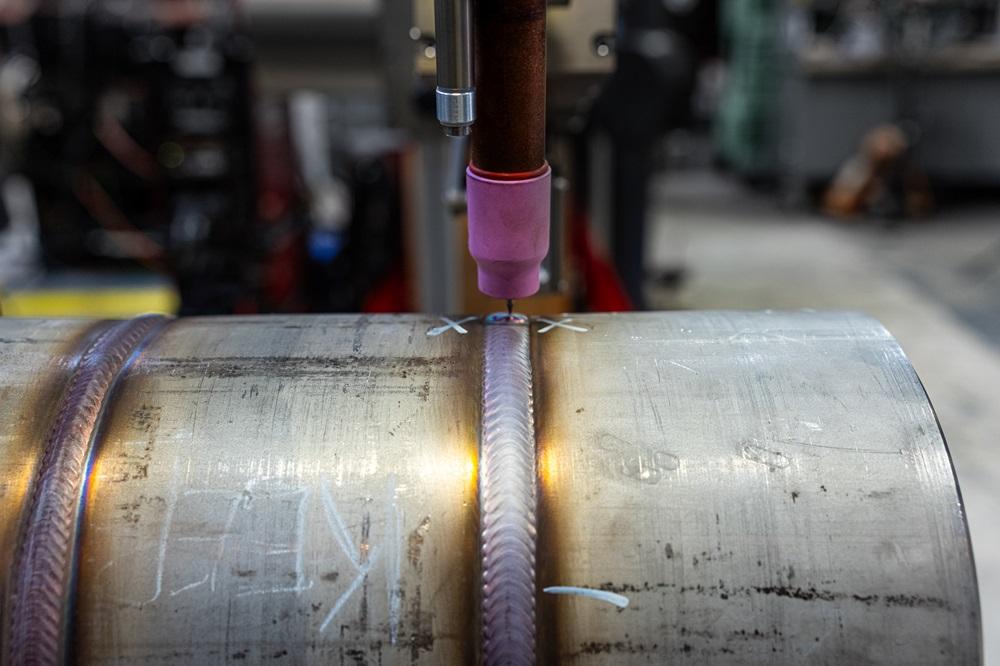
Automatic TIG welding systems address the workforce constraint by converting armature welding from an artisan skill into a controlled, programmable process. Rather than requiring a seasoned welder to manually execute hundreds of individual welds per armature — maintaining consistent torch angle, travel speed, and current throughout hours of repetitive work — automated systems handle indexing, weld cycle control, current management, and heat build-up mitigation without constant human intervention. An operator monitors the process while the machine performs the work, freeing skilled personnel for higher-judgment tasks that genuinely require their expertise.
The quality argument for automation is equally compelling, and arguably more important over the long term. Manual welding on commutator risers introduces variability that compounds across the life of a motor. Torch position inconsistencies, fatigue-driven current fluctuations between the third hour and the eighth hour of a shift, and operator-to-operator technique differences all contribute to weld quality variance that can result in premature motor failure and warranty exposure. Automated TIG welding systems eliminate these variables systematically. Optical sensors detect mica between commutator bars, automatically adjust current levels at the appropriate moment in each weld cycle, and count bars throughout the process — producing repeatable, consistent welds regardless of shift, operator, or time of day.
For repair centers processing varied armature sizes, the flexibility of modern automated welding systems matters as much as the consistency. Systems designed with wide capacity ranges and tool-free setup centers allow facilities to move between different armature diameters and lengths without extended reconfiguration downtime. High-production centers running similar armatures benefit from the throughput repeatability, while general repair shops handling diverse equipment across mining, transit, and industrial sectors need the adaptability that programmable weld recipes provide. Storing separate weld programs for each armature reference means operators call up the correct parameters at setup rather than re-engineering the process from scratch each time a different armature comes through.
Throughput, Turnaround, and Return on Investment
The return-on-investment case for automated TIG welding has strengthened consistently as labor costs have risen and availability has contracted. Armatures that previously required multiple hours of manual welding per unit can be processed in a fraction of that time with automated systems — a productivity differential that translates directly to throughput capacity, labor cost per unit, and competitive positioning in a market where turnaround time increasingly differentiates repair vendors from one another.
For heavy traction motor and mining equipment applications where armatures are large and weld counts per armature run into the hundreds, the time savings are most dramatic. A single skilled welder working manually might process one or two large armatures per shift. Automated welding systems routinely handle that same volume with oversight rather than hands-on execution, leaving the technician available for other repair steps throughout the cycle. Over a week, a month, or a year of operations, that capacity difference accumulates into a substantial competitive advantage. Facilities that have made the investment report automated systems paying for themselves within two to three years through labor savings and throughput gains combined.
Programmable heat management is a particularly important capability for high-value armature work. Larger armatures require controlled pauses between weld sequences to prevent thermal buildup that degrades insulation integrity. Automated systems execute these programmed interruptions consistently, protecting armature quality throughout long weld cycles that would be difficult for a manual welder to execute with the same discipline over extended periods.
Understanding which specific system configuration — horizontal or vertical — best fits a given operation’s workflow, floor space, and armature profile is a critical downstream decision covered in Horizontal vs. Vertical TIG Welders: Choosing the Right Armature Welding System.
Integration With the Broader Motor Repair Workflow
Automated TIG welding delivers its greatest value when integrated thoughtfully into the complete armature repair sequence. Facilities that position automated welding downstream of other automated processes — undercutting, banding, coil end trimming — benefit from the cumulative throughput gains of a connected automation chain rather than isolated pockets of automation surrounded by manual bottlenecks.
For operations managing heavy armatures from rail traction, mining haulage, and steel mill applications, the handling dimension of this integration matters enormously. Crane time, rigging transitions, and repositioning between processes represent both a time cost and a damage risk. Horizontal welding systems that receive armatures directly in the position they occupied throughout prior processes eliminate reorientation handling entirely. Vertical systems conserve floor space at the cost of that handling continuity — a trade-off examined in depth in the configuration comparison article.
Optional coil end cut-off saws integrated into horizontal welding systems further compress the process sequence, eliminating a standalone handling step that would otherwise require moving the armature to a separate machine, performing the cut-off, and returning it to the welding station.
The workforce pressures accelerating automation investment across the industry are examined in depth in The Skilled Welder Shortage Is Reshaping Motor Repair Shop Economics.
CAM Innovation: Your Partner in Advanced Motor Manufacturing
At CAM Innovation, we specialize in precision equipment solutions for DC motor repair and manufacturing operations seeking to improve quality, throughput, and workforce resilience through automation. Our team understands the specific demands of armature welding across traction, mining, industrial, and commercial motor applications.
Our Services Include:
- Automatic TIG Welders — CWM Horizontal and VWT Vertical TIG welding systems engineered for armature welding applications from light repair to heavy industrial production
- DC Motor Equipment — Complete line of automatic undercutters, banding machines, and armature processing equipment designed for heavy-duty motor repair
Ready to automate your welding operation? Contact CAM Innovation to discuss your armature specifications and request a cycle time estimate.
Works Cited
“AWS Welding Workforce Data.” American Welding Society Foundation, weldingworkforcedata.com. Accessed 24 Mar. 2026.
“Welders, Cutters, Solderers, and Brazers.” Occupational Outlook Handbook, U.S. Bureau of Labor Statistics, www.bls.gov/ooh/production/welders-cutters-solderers-and-brazers.htm. Accessed 24 Mar. 2026.
Related Articles
- The Skilled Welder Shortage Is Reshaping Motor Repair Shop Economics
- Horizontal vs. Vertical TIG Welders: Choosing the Right Armature Welding System