The Bureau of Labor Statistics still tracks Coil Winders, Tapers, and Finishers as a separate occupation, SOC 51-2021. National estimates appear in the May 2025 wage data, released on May 15, 2026. That classification survives because the work has never fully automated. It also explains why coil winding line design keeps landing on capital plans.
A winding line is not one machine. It is a sequence. Wire or strip comes off a dereeler, passes through a tension device, and gets wound to a turn count. Forming, taping, and pressing follow. Every station sets a limit on the one after it. Design the line around the wrong constraint and the investment buys nothing.
Start with the four numbers that actually govern the layout
CAM Innovation publishes a Winding Line Design Guide built around four inputs: production rate, space, budget, and quality. Those four decide almost everything else.
Production rate sets how much of the line needs automation and how much can stay manual. Space decides whether the winder, the dereelers, and the taping station sit in line or in a cell. Budget determines how many stations get automated in the first phase. Quality, meaning dimensional consistency from coil to coil, decides how much control the winder itself needs.
Shops that skip this step usually buy a fast winder and discover the bottleneck moved downstream to taping.
The winder is where repeatability is won or lost
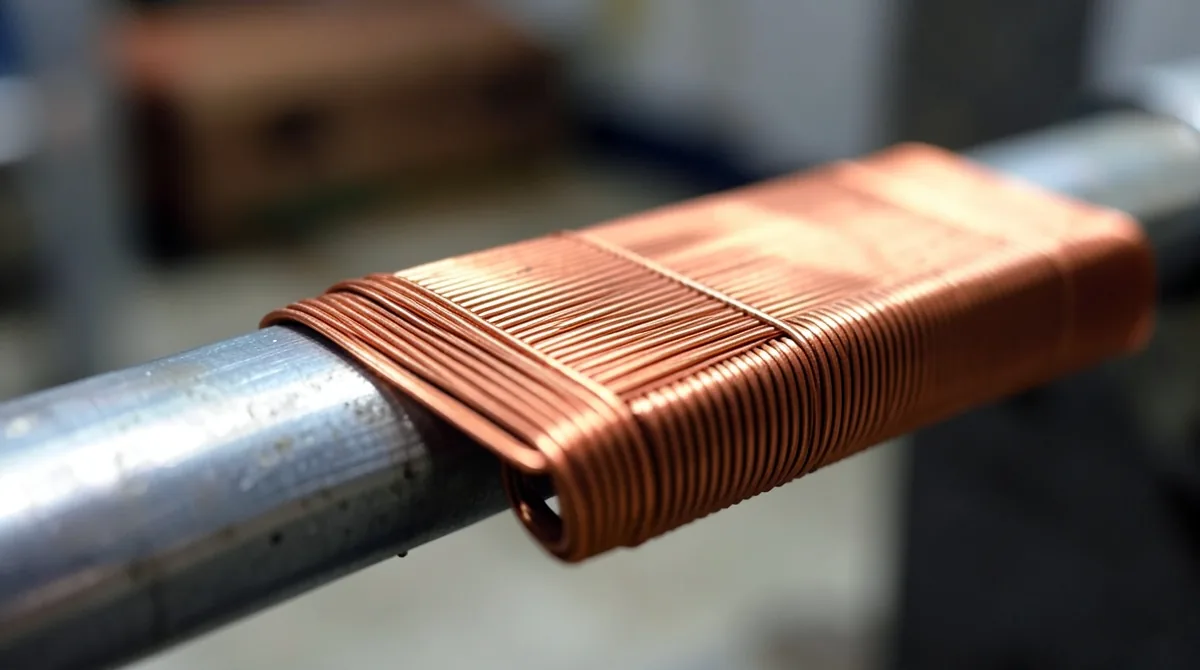
A coil that leaves the winder with the wrong turn count is scrap before anyone touches it. A coil wound at inconsistent tension sits differently in the slot after forming.
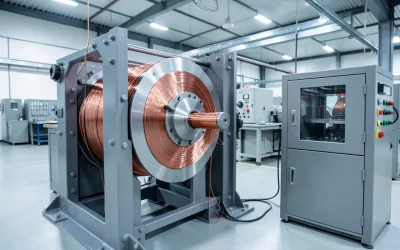
CAM’s loop winders address both directly. A pre-set counter stops winder rotation once the programmed number of revolutions is reached. Turn count no longer depends on an operator keeping tally. Controls cover emergency stop, spindle rotation speed, and spindle direction. The published feature list also names continuously variable speed, simple operation, low running costs, automatic turn count, and AC vector drive.
That combination matters more as experience thins out. Department of Labor occupational data puts training for this job at anywhere from a few days to a year. That is a wide band for work where one miscount ruins the part.
Plan the line, not just the machine
The loop winder page describes options that only make sense as line decisions rather than machine decisions. Winders can be ordered with integrated cabling for use with turn taping machines, wire tension devices, and smart dereelers. They can be prewired for light curtain or safety mat integration, though the light curtains and mats themselves are not included.
Prewiring is the detail worth catching early. Adding guarding integration to a machine already on the floor is a retrofit. Specifying it at order is a checkbox.
CAM also offers a range of loop bar accessories, and builds a custom winder when a requirement falls outside standard machine specifications.
Wet winding is a separate design problem
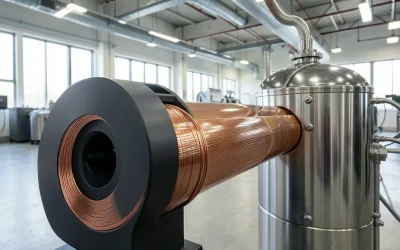
Lines that wind rotor coils with epoxy carry a second set of constraints. The Rotor Coil Winding System controls winding tension automatically while applying epoxy at a controlled rate. The epoxy sits in a closed pressure vessel rather than an open container exposed to ambient air and airborne contaminants.
A measured back bend is induced in the wire so it lies flat as the traversing mechanism winds it. The published result is straight, consistent layers with minimal operator intervention and no hammering. Any line that includes this station needs to account for the pressure tank, the applicator, and the die in the footprint.
Sequencing the investment
Most shops automate in phases. The order that tends to hold up:
- Winding first, because turn count and tension errors propagate into every downstream station
- Taping second, since overlap consistency drives insulation quality and is slow by hand
- Forming and pressing third, once upstream output is steady enough to justify the throughput
Broader manufacturing conditions support taking this in stages. Federal Reserve figures released in July 2026 put manufacturing capacity utilization at 75.7 percent for June. The index for electrical equipment, appliances, and components fell that month. Capacity exists. Predictable output is what is scarce.
Good coil winding line design answers one question per station. What does this machine have to repeat, and what breaks downstream when it does not?
Frequently Asked Questions About Coil Winding Line Design
01What is a coil winding line?
A coil winding line is the sequence of stations that turns raw wire or strip into a finished coil. Wire comes off a dereeler, passes through a tension device, and gets wound to a turn count. Forming, taping, and pressing follow, and each station limits the one after it.
02How do I size a coil winding line for my production rate?
CAM Innovation’s Winding Line Design Guide works from four inputs: production rate, space, budget, and quality. Production rate sets how many stations need automation. Space decides whether the line runs straight or as a cell. Budget decides which stations get automated in the first phase.
03Do I need to automate an entire winding line at once?
No. Most coil shops automate in phases. Winding tends to come first, because turn count and tension errors carry into every station downstream. Taping follows, since overlap consistency is slow to hold by hand. Forming and pressing come last, once upstream output is steady.
04What does a loop winder actually do?
A loop winder winds form coil loops to a set turn count. CAM Innovation’s loop winders use AC motors with vector drives, so speed selection is continuously variable. A pre-set counter stops rotation when the programmed revolution count is reached, and controls cover emergency stop, speed, and direction.
05Can a winder be built for a part outside standard machine specifications?
Yes. CAM Innovation builds a custom winder when a requirement falls outside its standard machine specifications. Winders can also be ordered with integrated cabling for turn taping machines, wire tension devices, and smart dereelers, along with a range of loop bar accessories for the winding operation.
CAM Innovation: Custom Machinery for Motor and Coil Manufacturing
CAM Innovation builds custom automated machinery for the electric motor and coil manufacturing industry from Hanover, Pennsylvania. Every machine is Made in USA and designed around the process the customer actually runs.
Our Equipment Includes:
- Loop and Wet Winding Machines — Loop winders, winding beams, and drum stands for form coil work
- Coil Manufacturing Equipment — Taping, forming, pressing, and winding systems for AC and DC form coils
Automating a process? Contact CAM Innovation to discuss your part, your volume, and your shop layout.
Works Cited
- U.S. Bureau of Labor Statistics. “May 2025 Occupation Profiles.” Occupational Employment and Wage Statistics, U.S. Department of Labor, 15 May 2026, https://www.bls.gov/oes/current/oes_stru.htm.
- U.S. Department of Labor, Employment and Training Administration. “51-2021.00 — Coil Winders, Tapers, and Finishers.” O*NET OnLine, 2026, https://www.onetonline.org/link/summary/51-2021.00.