Railroad and Mining Motor Maintenance Drives Industrial Taping Machine Investment

CAM Innovation: Engineering Excellence in Motor Production Equipment Since 1910
The global locomotive maintenance market reached $5.9 billion in 2025 and is projected to grow to $8.3 billion by 2035, driven by expanding rail networks, aging fleet modernization requirements, and increasing emphasis on operational efficiency across freight and passenger transportation systems worldwide. This growth creates sustained demand for specialized equipment supporting motor repair and remanufacturing operations—including precision taping systems essential for professional-grade insulation restoration that meets original equipment specifications.
Engine components dominate locomotive maintenance expenditures, holding approximately 34.2 percent of market revenue as the most complex and high-stress equipment requiring frequent inspection, repair, and part replacement according to industry analysis. Traction motors represent critical elements within this category, converting electrical energy into mechanical force that drives locomotives across global rail networks serving both freight and passenger transportation requirements. Proper insulation of motor coils, armatures, and connections directly affects motor reliability, efficiency, and service life throughout demanding operational environments.
Mining operations face parallel equipment maintenance challenges with large motors powering haul trucks, excavators, conveyors, and processing equipment in harsh environments characterized by dust, vibration, temperature extremes, and continuous heavy loading. The mining industry presents specific demand for heavy-duty taping equipment capable of addressing the motor repair requirements these demanding applications generate. Understanding how maintenance operations approach equipment investment helps manufacturers and service providers optimize their capabilities for evolving market demands.
Railroad Industry Maintenance Dynamics
North America maintains substantial locomotive maintenance requirements with freight and passenger rail operations depending on reliable motor performance for transportation efficiency across extensive networks. Class I railroads operate fleets requiring continuous maintenance cycles that include motor rebuilding and coil restoration to maintain service reliability and regulatory compliance. The complexity of modern locomotive electrical systems drives demand for precision repair capabilities that meet original equipment specifications while supporting extended service intervals.
According to comprehensive manufacturing statistics compiled by the National Institute of Standards and Technology, U.S. manufacturing value added reached significant levels with motor and generator manufacturing representing substantial segments of broader industrial output. This manufacturing base supports both new equipment production and the maintenance infrastructure that keeps existing equipment operational throughout extended service lives measured in decades for railroad applications.
Predictive maintenance adoption is transforming railroad maintenance practices significantly, with IoT sensors and AI-powered analytics enabling real-time monitoring of motor condition indicators including temperature, vibration, and electrical characteristics. These technologies identify developing issues before failures occur, allowing maintenance scheduling that minimizes downtime while ensuring equipment reliability. The digital transformation of maintenance operations creates demand for repair capabilities that match the precision monitoring enables—including professional-grade insulation restoration using appropriate taping equipment.
The transition from diesel-powered to electric-powered trains represents a major industry trend increasing demand for electric traction motors across multiple rail categories. Electrification projects prioritize energy efficiency and emissions reduction, driving investment in electric motor production and maintenance infrastructure. This shift creates opportunities for equipment suppliers addressing both new motor manufacturing and ongoing maintenance requirements throughout extended equipment service lives. For broader context on how motor manufacturing equipment investment is evolving, examining Spiral Wrap Taping Technology Transforms Motor and Wire Harness Manufacturing provides comprehensive industry perspective.
Mining Equipment Maintenance Requirements
Mining operations impose extreme demands on electrical equipment, with motors operating in harsh environments featuring pervasive dust, continuous vibration, temperature extremes ranging from subzero to desert conditions, and sustained heavy loads that stress all system components. Haul truck motors, conveyor drives, crusher equipment, and processing systems require robust maintenance programs to prevent costly production interruptions that can affect entire mining operations when critical equipment fails.
Motor repair and remanufacturing services support mining operations by extending equipment life while maintaining performance specifications that ensure operational efficiency. The economic consequences of motor failures in mining applications—including production losses, emergency repair costs, and potential safety implications—justify investment in maintenance capabilities that ensure reliable repairs meeting original equipment standards. Professional taping equipment supports these quality requirements by enabling consistent insulation application across diverse motor configurations.
Traction motor maintenance encompasses multiple repair categories including coil rewinding, insulation restoration, bearing replacement, commutator reconditioning, and comprehensive electrical testing before equipment returns to service. Each category demands specialized equipment and expertise, with proper insulation application representing a critical quality determinant affecting motor performance, efficiency, and longevity throughout demanding operational cycles. Facilities performing this work require taping equipment capable of professional-grade results on irregular geometries and custom configurations common in heavy industrial motor applications.
The heavy equipment motor repair market serves both railroad and mining customers with overlapping equipment requirements and shared technical challenges. Large DC motors, AC traction systems, and generator equipment require similar maintenance approaches regardless of specific application, creating opportunities for service providers developing expertise applicable across multiple market segments. Understanding the wire harness connections supporting these motor systems provides additional context, as explored in Wire Harness Automation Demands Advanced Taping Solutions for Motor Production.
Technical Requirements for Maintenance Taping
Motor maintenance taping applications present unique challenges compared to new equipment manufacturing due to the variety of configurations, repair requirements, and original equipment specifications that must be matched or exceeded. Maintenance facilities handle motors from multiple manufacturers spanning decades of production, requiring equipment flexibility that accommodates diverse dimensional requirements and insulation system designs without extensive setup changes.
Coil insulation restoration demands precise tape application achieving consistent overlap throughout complex geometries including slot sections, end turns, and connection areas. High-voltage motor coils require multiple insulation layers applied with controlled tension to meet electrical performance and safety standards—specifications that professional repair facilities must satisfy to maintain their reputation and customer relationships. The consequences of insulation failures in these applications justify equipment investments ensuring reliable tape application quality.
Research from institutions like Carnegie Mellon University demonstrates how federal incentives including the Inflation Reduction Act encourage diversification and domestic production of critical electric vehicle components, helping to mitigate supply chain vulnerabilities while building more resilient North American manufacturing capabilities. This policy environment supports investment in motor production and maintenance infrastructure including the equipment enabling professional-quality repairs.
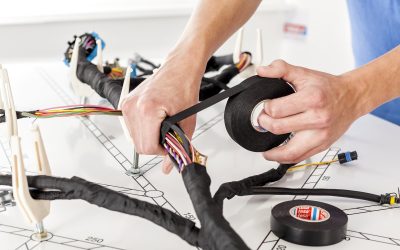
Semi-automatic taping systems address maintenance application requirements through operator-controlled workpiece positioning combined with automated tape application that ensures consistent overlap and tension throughout taping operations. This combination proves ideal for maintenance environments where each motor may present unique configuration requirements while quality standards remain constant across all work. Operators can position irregular workpieces appropriately while equipment maintains the mechanical precision that manual taping struggles to achieve consistently.
Equipment Selection for Maintenance Operations
Maintenance facility equipment requirements differ from high-volume manufacturing in important ways that affect equipment selection decisions. Production facilities optimize for throughput and consistency across identical assemblies, while maintenance operations prioritize flexibility and the ability to address diverse equipment configurations efficiently. This distinction favors semi-automatic equipment that combines operator judgment with mechanical precision over fully automated systems designed for repetitive operations.
Manual spiral taping machines suit maintenance facilities handling low volumes or highly variable work requiring maximum flexibility and operator control throughout taping operations. These systems rely on operator skill for workpiece movement and overlap control while providing mechanical tape dispensing and tensioning that improves efficiency compared to completely manual methods. Facilities with experienced technicians and diverse equipment requirements often find manual systems appropriate for their operational needs.
Semi-automatic taping machines provide enhanced consistency through ratio-controlled overlap combined with powered drive systems that maintain steady workpiece feed rates. These systems reduce operator skill dependencies while maintaining flexibility for diverse configurations—a balance that suits many maintenance operations serving multiple equipment types and customer requirements. The programmable overlap control enables quick adjustment between different specifications without mechanical setup changes.
Follower taping systems address specific applications involving long cable assemblies or continuous production requirements where maintaining consistent tape application throughout extended lengths proves critical. While less common in traditional motor maintenance, these systems serve facilities handling cable harness production, long buss bar assemblies, or continuous insulation applications where maintaining overlap consistency throughout extended production runs justifies specialized equipment investment.
Workforce Development and Training Considerations
The specialized skills required for professional motor maintenance create workforce development challenges that equipment selection can address effectively. Experienced motor repair technicians possess valuable knowledge spanning electrical theory, mechanical systems, and quality requirements—expertise that facilities want to preserve and leverage rather than burden with repetitive manual tasks that equipment can perform more consistently.
Training requirements for taping equipment operation vary significantly based on automation level and system complexity. Semi-automatic systems allow technicians to achieve consistent results relatively quickly compared to the extended practice required for skilled manual taping. This training efficiency proves valuable for facilities facing technician turnover or expanding their service capabilities with additional personnel who can contribute productively while developing broader motor repair expertise.
The combination of experienced technician judgment with equipment-assisted precision represents an effective approach for many maintenance operations. Technicians assess repair requirements, prepare components, and position workpieces appropriately while equipment handles the mechanical tape application that determines insulation quality. This division of responsibilities leverages technician expertise for high-value decisions while ensuring consistent execution of critical operations.
CAM Innovation: Your Partner in Motor Production Excellence
CAM Innovation has specialized in machinery for building and repairing large motors since 1910, serving customers in over 60 countries including the world’s leading railroads, mining equipment companies, and electrical equipment manufacturers. Our roots trace to serving steel manufacturing, mining, shipbuilding, and streetcar systems—industries that continue relying on professional motor maintenance capabilities today.
Our Services Include:
- Automatic Spiral Wrap Taping Machines – CT Manual, RHT Semi-Automatic, and FT Follower systems for motor repair and maintenance operations
- Custom Equipment Solutions – Tailored machinery addressing specific railroad and mining motor maintenance requirements
Ready to Transform Your Operations? Contact CAM Innovation to discuss how our taping solutions can enhance your motor maintenance and repair capabilities.
Works Cited
Michalek, Jeremy, et al. “The Infrastructure Effect: A Made-in-America Battery Supply Chain.” Carnegie Mellon University College of Engineering, energy.cmu.edu/news/2025/05/01-infrastructure-supply-chain.html. Accessed 1 Feb. 2026.
Thomas, Douglas S. “Annual Report on U.S. Manufacturing Industry Statistics: 2021.” NIST Advanced Manufacturing Series 100-42, National Institute of Standards and Technology, nvlpubs.nist.gov/nistpubs/ams/NIST.AMS.100-42.pdf. Accessed 1 Feb. 2026.
Related Articles
- Spiral Wrap Taping Technology Transforms Motor and Wire Harness Manufacturing
- Wire Harness Automation Demands Advanced Taping Solutions for Motor Production