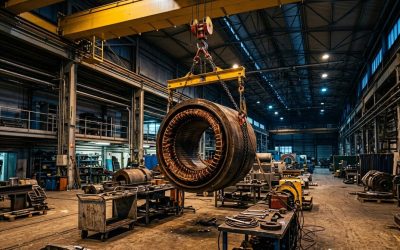
Industrial Banding Machine Solutions for Motor Manufacturing and Electrical Equipment Assembly
Manufacturing facilities across heavy industry sectors face constant pressure to maintain secure, reliable electrical connections in their motor assemblies. When armature windings, coil assemblies, or wire bundles fail due to inadequate securing methods, the resulting downtime can cost thousands of dollars per hour. Professional banding machines provide the precision and consistency needed to prevent these costly failures while streamlining production workflows.
CAM Innovation’s specialized banding machine solutions deliver the industrial-grade performance required for demanding motor manufacturing and electrical equipment applications. These precision-engineered systems ensure consistent tension control and reliable band placement across diverse production environments.
Understanding Industrial Banding Machine Technology
Industrial banding machines represent a significant advancement over manual bundling methods in motor manufacturing applications. These automated systems apply consistent tension and secure placement of banding materials around wire bundles, coil assemblies, and component groups. The technology eliminates variability associated with manual processes while significantly increasing throughput rates.
Modern banding machines incorporate servo-driven mechanisms that provide precise control over band tension, placement accuracy, and cycle timing. This level of control proves critical when securing delicate armature windings or complex coil configurations where excessive tension can damage components while insufficient tension results in assembly failures.
Key Components of Professional Banding Systems
Professional-grade banding machines integrate several critical subsystems to deliver consistent results. The tensioning mechanism maintains precise band tightness across varying bundle diameters and material types. Feed systems ensure smooth, continuous operation without material jams or misalignment issues. Cutting assemblies provide clean, consistent band termination to prevent sharp edges that could damage adjacent components.
Control systems manage the entire banding cycle, from initial positioning through final cut-off. Advanced models feature programmable tension settings, adjustable cycle times, and diagnostic capabilities that monitor system performance and predict maintenance requirements.
Applications in Motor Manufacturing Industries
Motor manufacturing facilities require specialized banding solutions for diverse assembly processes. Armature winding applications demand precise tension control to secure wire bundles without damaging delicate conductors. Stator assembly processes benefit from consistent band placement that maintains proper spacing and alignment of coil groups.
Field coil manufacturing operations utilize banding machines to secure individual coil assemblies before installation into larger motor assemblies. The consistent band placement ensures proper coil positioning while preventing wire movement during subsequent manufacturing steps.
Automotive Motor Production Requirements
Automotive manufacturing environments present unique challenges for banding operations. High-volume production lines require machines capable of continuous operation with minimal downtime. Band placement must accommodate varying motor sizes and configurations while maintaining consistent quality standards across all production runs.
Automotive applications often involve hybrid and electric vehicle motor assemblies where precise wire management directly impacts electromagnetic performance. Banding machines configured for these applications provide the accuracy needed to maintain critical spacing requirements while ensuring long-term reliability under automotive operating conditions.
Heavy Industry Applications Beyond Motor Manufacturing
Mining equipment manufacturers utilize industrial banding machines for securing cable assemblies and wire harnesses in harsh operating environments. The robust construction of professional banding equipment withstands the demanding conditions typical of heavy machinery production facilities while delivering consistent results across varying bundle sizes and configurations.
Oil and gas industry applications require banding solutions capable of handling specialized materials and extreme environmental considerations. Equipment manufacturers serving these sectors depend on banding machines that accommodate protective coverings, specialized insulation materials, and corrosion-resistant banding products.
Edge-wound coil technology demonstrates how advanced manufacturing techniques complement precision banding operations in mining and heavy manufacturing applications. The integration of these technologies creates comprehensive solutions for demanding industrial environments.
Power Generation Equipment Assembly
Power generation equipment assembly operations benefit from precision banding machines designed for large-scale component manufacturing. Generator winding applications require specialized fixtures and tooling to accommodate the substantial size and weight of power generation coils. Banding machines configured for these applications provide the mechanical strength and precision needed for successful assembly operations.
Transformer manufacturing facilities utilize banding equipment for securing core assemblies and managing complex winding configurations. The ability to program specific tension levels and band placement patterns proves essential for maintaining proper electromagnetic characteristics in finished transformers.
Comparing Manual vs Automated Banding Methods
Manual banding methods introduce significant variability in tension application and band placement consistency. Operator fatigue, skill level variations, and time pressures contribute to inconsistent results that can compromise assembly quality. Production rates remain limited by human capabilities, creating bottlenecks in high-volume manufacturing environments.
Automated banding machines eliminate human variability while providing consistent, repeatable results across all production runs. Cycle times remain constant regardless of operator experience or facility conditions. Quality improvements result from precise tension control and accurate band placement that manual methods cannot match.
Cost Analysis of Banding Method Options
Initial investment requirements for automated banding equipment appear substantial compared to manual tooling costs. Production volume analysis reveals the economic benefits of automation through reduced labor costs, improved quality metrics, and increased throughput capabilities. Return on investment calculations typically demonstrate payback periods of 12-18 months in moderate to high-volume production environments.
Maintenance costs for automated systems remain predictable through scheduled preventive maintenance programs. Manual methods incur ongoing costs through tool replacement, training requirements, and quality-related rework expenses that prove difficult to quantify and control.
Technical Specifications for Industrial Applications
Industrial banding machines accommodate band materials ranging from plastic strapping to steel banding depending on application requirements. Tension control systems provide adjustable force settings from light-duty applications requiring minimal pressure to heavy-duty installations demanding substantial securing force.
Bundle diameter capacity varies significantly among machine models, with standard units accommodating bundles from 0.5 inches to 6 inches in diameter. Specialized models extend this range to handle larger assemblies common in power generation and heavy industrial applications.
Performance Metrics and Capabilities
Cycle time performance varies based on bundle size, band material, and tension requirements. Standard production rates range from 60 to 120 cycles per minute depending on application specifics. Advanced models incorporate multiple banding heads to increase throughput while maintaining quality standards.
Tension accuracy specifications typically maintain tolerances within ±5% of programmed settings across the full operating range. This consistency proves critical for applications where band tension directly impacts component performance or assembly integrity.
Maintenance Requirements for Optimal Performance
Preventive maintenance programs for industrial banding machines focus on mechanical components subject to wear during normal operation. Cutting blade replacement schedules depend on band material types and production volume levels. Tensioning mechanism adjustments maintain consistent performance across varying operating conditions.
Lubrication schedules for moving components prevent premature wear while ensuring smooth operation throughout extended production runs. Control system diagnostics identify potential issues before they impact production schedules, enabling proactive maintenance interventions.
Troubleshooting Common Operating Issues
Band feeding problems typically result from improper material loading or worn feed mechanism components. Regular inspection of guide rollers and feed paths prevents material jams and reduces unplanned downtime. Tension variation issues often indicate worn tensioning components or control system calibration requirements.
Cutting quality problems manifest as incomplete cuts or rough band edges that can damage adjacent components. Blade replacement and cutting mechanism adjustment procedures address these issues while maintaining production schedules.
Integration with Existing Production Systems
Modern banding machines accommodate integration with existing production line control systems through standard industrial communication protocols. Programmable logic controller interfaces enable coordinated operation with upstream and downstream manufacturing processes.
Quality control systems benefit from integration capabilities that track banding parameters for each assembly. Data collection features support statistical process control initiatives while providing traceability for quality assurance requirements.
The evolution of banding machines demonstrates how technological advances continue to improve packaging efficiency and operational reliability across diverse industrial applications. These innovations directly impact production line performance and overall manufacturing effectiveness.
Workflow Optimization Strategies
Production line layout considerations impact banding machine effectiveness and overall workflow efficiency. Strategic positioning minimizes material handling requirements while maintaining accessibility for maintenance operations. Fixture design accommodates varying product configurations without requiring extensive changeover procedures.
Operator training programs ensure proper machine operation while maximizing productivity benefits. Standard operating procedures maintain consistent results across multiple shifts and production schedules.
Quality Control and Testing Protocols
Quality control protocols for banded assemblies focus on band placement accuracy, tension consistency, and overall assembly integrity. Tension testing equipment verifies band tightness meets specification requirements across sample populations. Visual inspection criteria identify potential issues with band placement or cutting quality.
Statistical process control methods track key performance indicators over time to identify trends that might indicate maintenance requirements or process adjustments. Documentation systems maintain traceability for assemblies requiring quality certification or regulatory compliance.
Industry Standards and Compliance Requirements
Manufacturing facilities serving regulated industries must maintain compliance with relevant quality standards and certification requirements. Banding operations contribute to overall assembly quality metrics that impact product certification and customer acceptance criteria.
Documentation requirements for quality systems include banding parameters, maintenance records, and operator qualifications. Audit trail capabilities support regulatory compliance while providing data for continuous improvement initiatives.
Economic Benefits of Professional Banding Solutions
Professional banding machine investments deliver measurable returns through labor cost reductions, quality improvements, and increased production capacity. Automated systems eliminate the variability associated with manual processes while reducing skill level requirements for operators.
Productivity improvements result from consistent cycle times and reduced setup requirements between product changeovers. Quality-related cost savings include reduced rework, improved customer satisfaction, and fewer warranty claims related to assembly failures.
Return on Investment Calculations
Investment analysis for banding equipment considers initial equipment costs, installation expenses, and training requirements against ongoing operational savings. Labor cost reductions typically account for the largest portion of operational savings, particularly in high-volume production environments.
Quality improvement benefits contribute to long-term cost savings through reduced warranty claims, improved customer satisfaction ratings, and enhanced market reputation. These factors prove difficult to quantify but represent significant value in competitive markets.
Selecting the Right Banding Machine for Your Application
Application analysis forms the foundation for proper banding machine selection. Bundle diameter ranges, material types, and production volume requirements determine the appropriate machine specifications. Tension requirements and band material compatibility influence system configuration and optional features.
Environmental considerations impact machine construction and protective features required for reliable operation. Temperature extremes, humidity levels, and contamination exposure affect component selection and maintenance requirements.
Feature Comparison and Selection Criteria
Standard features include adjustable tension control, programmable cycle parameters, and basic diagnostic capabilities. Advanced options encompass multiple banding head configurations, automated material loading systems, and comprehensive data collection interfaces.
Integration capabilities with existing production systems influence feature selection and system configuration requirements. Communication protocol compatibility and control system interfaces determine the complexity of installation and commissioning procedures.
Installation and Commissioning Requirements
Installation planning addresses facility requirements, utility connections, and safety considerations for banding machine deployment. Floor space requirements vary based on machine configuration and optional features selected. Electrical requirements include power supply specifications and control system interfaces.
Compressed air systems provide power for pneumatic components and material handling mechanisms. Air quality requirements include filtration and moisture removal to prevent component contamination and premature wear.
Training and Support Services
Operator training programs cover machine operation, basic maintenance procedures, and troubleshooting techniques. Comprehensive training reduces startup time and ensures optimal machine performance from initial deployment. Advanced training modules address preventive maintenance procedures and component replacement techniques.
Technical support services provide ongoing assistance for operational issues and maintenance questions. Remote diagnostic capabilities enable rapid problem identification and resolution without requiring on-site service visits.
Future Developments in Banding Technology
Technological advances continue to improve banding machine capabilities and expand application possibilities. Servo-driven systems provide enhanced precision and control over traditional pneumatic mechanisms. Smart sensors enable real-time monitoring and predictive maintenance capabilities.
Integration with Industry 4.0 initiatives creates opportunities for comprehensive data collection and analysis. Machine learning algorithms optimize operating parameters based on historical performance data and production requirements.
Market Trends and Industry Adoption
Market adoption of automated banding solutions continues to accelerate across diverse industrial sectors. Cost pressures and quality requirements drive the transition from manual methods to automated systems. Regulatory compliance requirements support investment justification for quality-related improvements.
Customization capabilities enable banding solutions for specialized applications and unique requirements. Modular system designs accommodate future expansion and configuration changes without requiring complete system replacement.
Schedule Your Banding Machine Consultation Today
Industry Standards and Compliance Resources
Professional banding operations must comply with relevant industry standards and regulatory requirements. The Occupational Safety and Health Administration (OSHA) provides comprehensive guidelines for workplace safety requirements related to industrial machinery operation and maintenance. These standards address operator training, safety procedures, and equipment specifications necessary for compliant operations.
The National Institute of Standards and Technology (NIST) establishes measurement standards and quality control protocols that impact banding machine calibration and performance verification. Compliance with these standards ensures consistent operation and traceability for quality assurance programs.
Frequently Asked Questions
What types of band materials can industrial banding machines handle?
Professional banding machines accommodate a wide range of materials including polyester strapping, polypropylene banding, steel strapping, and specialized composite materials. Material selection depends on application requirements such as tensile strength, environmental resistance, and electromagnetic compatibility. Polyester strapping provides excellent strength-to-weight ratios for general applications, while steel banding offers maximum strength for heavy-duty securing requirements. Composite materials combine specific properties for specialized applications such as chemical resistance or high-temperature operation.
How do I determine the correct tension setting for my specific application?
Tension setting determination requires analysis of bundle characteristics, band material properties, and application requirements. Bundle diameter and material compressibility influence the tension needed to maintain secure positioning without component damage. Band material specifications provide tensile strength limits and recommended tension ranges for optimal performance. Testing with sample assemblies at various tension levels helps establish the optimal setting that provides adequate security without compromising component integrity or assembly functionality.
What maintenance schedule should I follow for optimal banding machine performance?
Maintenance schedules depend on production volume, operating environment, and machine configuration. Daily inspections should include band feeding mechanisms, cutting blade condition, and lubrication point checks. Weekly maintenance involves tensioning system calibration, guide roller cleaning, and control system diagnostic review. Monthly procedures include comprehensive lubrication, wear component inspection, and performance parameter verification. Annual maintenance encompasses major component inspection, system calibration, and safety system testing to ensure continued reliable operation.
Can banding machines integrate with existing production line control systems?
Modern banding machines feature standard industrial communication protocols including Ethernet/IP, DeviceNet, and Profibus interfaces for seamless integration with existing control systems. Programmable logic controller connectivity enables coordinated operation with upstream and downstream processes. Data collection capabilities support real-time monitoring and statistical process control initiatives. Custom interface development accommodates unique integration requirements for specialized production environments.
What safety considerations apply to industrial banding machine operation?
Safety considerations include operator training requirements, machine guarding specifications, and emergency stop procedures. OSHA guidelines mandate proper training for all operators and maintenance personnel. Machine guarding must prevent access to moving components during operation while maintaining accessibility for maintenance procedures. Emergency stop systems require immediate response capability and safe machine shutdown procedures. Personal protective equipment requirements include eye protection, hearing protection, and appropriate clothing to prevent entanglement hazards.