The Motor Repair Industry’s $9 Billion Growth Surge Collides with a Vanishing Workforce
CAM Innovation: Precision Equipment for the Electrical Apparatus Industry
The global motor winding repair service market has crossed nine billion dollars and shows no signs of slowing. Industry projections peg growth at 5.2 percent annually through 2035, driven by aging industrial infrastructure, the rising cost of motor replacement, and expanding electrification across transportation and energy sectors. Yet behind these bullish numbers lies a crisis that threatens to cap the industry’s potential: the people who actually do the work are disappearing.
The Bureau of Labor Statistics paints a sobering picture. The agency projects approximately 9,600 annual openings for electrical and electronics installers and repairers through 2034, with the vast majority resulting not from industry expansion but from workers transferring to other occupations or exiting the labor force entirely—primarily through retirement. Overall employment in the field is projected to show little or no change over the decade, meaning the industry must replace its existing workforce just to maintain current capacity, let alone grow into the nine-billion-dollar opportunity the market presents.
The median annual wage of roughly seventy-one thousand dollars for these roles reflects the technical demands of the work, but it has proven insufficient to attract younger workers in competition with software engineering, healthcare, and other fields that carry stronger cultural cachet. Motor repair shops report that applicants who do appear often lack fundamental electrical knowledge, requiring months of on-the-job training before they can contribute productively—training that veteran technicians must deliver while simultaneously handling their own workloads.
A Generation of Knowledge Walking Out the Door
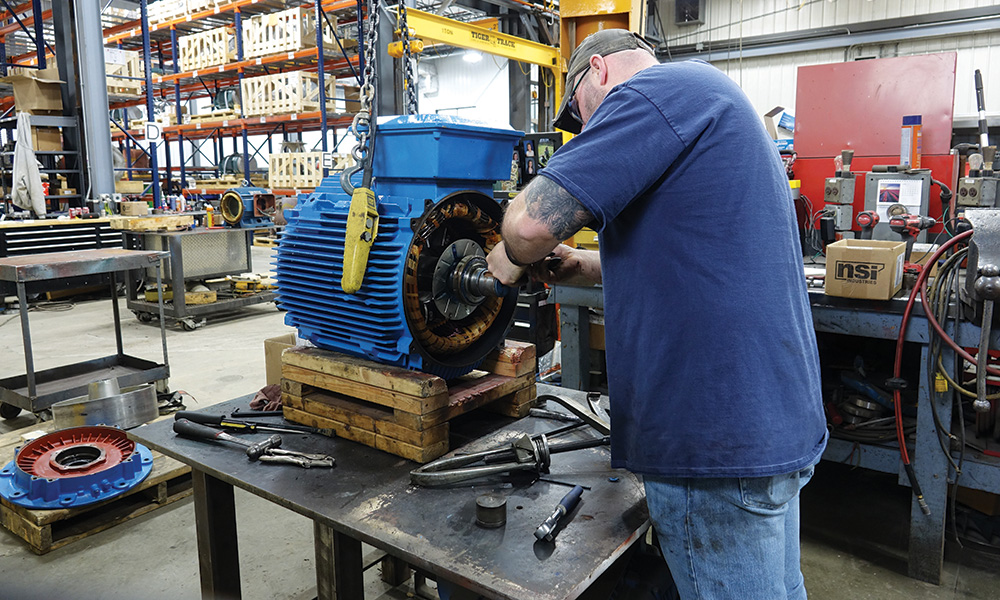
The workforce math is unforgiving. Experienced motor repair technicians who entered the trade in the 1970s and 1980s are retiring in waves. These workers carry decades of accumulated expertise in winding patterns, insulation systems, failure diagnosis, and the countless judgment calls that distinguish a properly rebuilt motor from one that will fail prematurely in the field. When they leave, institutional knowledge leaves with them—knowledge that cannot be transferred through manuals or classroom instruction alone.
The consequences cascade through operations. Shops that once maintained deep benches of skilled winders now operate with skeleton crews, turning away work or extending lead times that push customers toward purchasing new motors rather than repairing existing ones. In industries like oil and gas, mining, and water treatment—where large motors represent capital investments of tens or hundreds of thousands of dollars—extended repair timelines create costly downtime that reverberates through entire operations.
Copper costs intensify the pressure. With LME copper trading above thirteen thousand dollars per tonne in early 2026 and the USGS now classifying the metal as a critical mineral, the material waste inherent in manual wire preparation has become financially intolerable. The relationship between workforce constraints and material costs is explored thoroughly in Record Copper Prices Are Squeezing Motor Manufacturers—Why Precision Wire Processing Has Never Mattered More, which documents how every imprecise cut now carries a steeper penalty than at any point in the industry’s history.
EASA’s 1,900 Shops Face the Same Problem
The challenge is industry-wide. The Electrical Apparatus Service Association represents an international network of nearly 1,900 electromechanical sales and service firms spanning sixty countries. EASA provides engineering support, training programs, and the ANSI/EASA AR100 standard that governs best practices for rotating electrical apparatus repair. The organization’s extensive training infrastructure—webinars, conventions, and regional chapter meetings—reflects a recognition that workforce capability is the single largest constraint on industry growth.
EASA member shops range from small family operations running two or three technicians to large industrial service companies staffing dozens. Regardless of size, virtually all report the same fundamental challenge: finding qualified people to do the work. The technical barrier to entry is substantial. A competent motor repair technician must understand electromagnetic principles, insulation systems, mechanical tolerances, vibration analysis, and increasingly, digital diagnostic tools. Building this breadth of competence takes years of supervised practice that shops struggle to provide when every experienced technician is already stretched thin.
The association’s accreditation program establishes quality benchmarks that member shops must meet, but meeting those benchmarks requires skilled hands executing precise operations. Wire preparation—straightening, cutting to exact length, stripping insulation cleanly without conductor damage—represents one of the most labor-intensive and error-prone stages of the rewind process, yet it demands the least complex judgment. It is precisely the kind of operation where automation delivers the highest return by freeing skilled technicians to focus on tasks that genuinely require human expertise and experience.
Automation as Workforce Multiplier
The most forward-thinking shops are reframing automation not as a replacement for workers but as a force multiplier that enables existing staff to accomplish more. When a single technician can program an automated wire preparation system to straighten, strip, and cut hundreds of precise conductor segments while simultaneously performing diagnostic work on an incoming motor, the shop’s effective capacity expands without adding headcount.
This approach addresses the workforce shortage from both directions. Experienced technicians spend less time on repetitive preparation tasks and more time applying the diagnostic and winding expertise that only they possess. Meanwhile, newer employees with limited experience can operate programmable equipment that produces consistent results regardless of the operator’s skill level, accelerating their ability to contribute productively while they develop broader competencies under veteran supervision.
Digital diagnostic tools complement shop-floor automation. Predictive maintenance technologies using vibration analysis, thermal imaging, and motor circuit analysis help shops identify emerging failures before catastrophic breakdowns occur, shifting the industry from reactive repair toward proactive maintenance. Twenty-seven percent of repair facilities in North America and Europe have adopted digital diagnostic platforms, with early adopters reporting twenty-three percent improvements in repair accuracy. As federal efficiency regulations tighten—a dynamic examined in How DOE Motor Efficiency Standards Are Reshaping the Way Motors Get Built and Rewound—the precision these tools enable becomes essential for meeting compliance requirements that manual processes increasingly struggle to satisfy.
The Path Forward Is Equipment, Not Just Recruitment
The motor repair industry will not recruit its way out of this workforce crisis. The demographic math is too unfavorable, the competition for technical talent too intense, and the timeline for developing fully competent technicians too long. Shops that invest in automated equipment for repetitive, precision-dependent operations like wire preparation position themselves to grow revenue per employee, maintain quality standards with smaller teams, and create work environments that younger workers find more appealing than purely manual operations.
The nine-billion-dollar market opportunity is real. Capturing it requires acknowledging that the workforce of 2026 is fundamentally different from the workforce that built this industry, and equipping shops accordingly.
CAM Innovation: Your Partner in Motor Shop Automation
At CAM Innovation, we specialize in precision equipment solutions for the electrical apparatus industry. Built in Hanover, Pennsylvania, our machines are engineered to maximize the productivity of every technician on your shop floor.
Our Equipment Includes:
- RW Automatic Cut-to-Length & Insulation Stripping Machine – Automated wire straightening, measuring, cutting, and stripping that eliminates manual preparation bottlenecks
- Coil Manufacturing Equipment – Complete taping, forming, winding, and pressing solutions that multiply technician output
Ready to Do More with Your Current Team? Contact CAM Innovation to discuss how automated wire preparation can help your shop grow without the headcount you can’t find.
Works Cited
“Electrical and Electronics Installers and Repairers.” Occupational Outlook Handbook, U.S. Bureau of Labor Statistics, U.S. Department of Labor, www.bls.gov/ooh/installation-maintenance-and-repair/electrical-and-electronics-installers-and-repairers.htm. Accessed 24 Feb. 2026.
“About EASA.” Electrical Apparatus Service Association, easa.com/about-easa. Accessed 24 Feb. 2026.
Related Articles
- Record Copper Prices Are Squeezing Motor Manufacturers—Why Precision Wire Processing Has Never Mattered More
- How DOE Motor Efficiency Standards Are Reshaping the Way Motors Get Built and Rewound